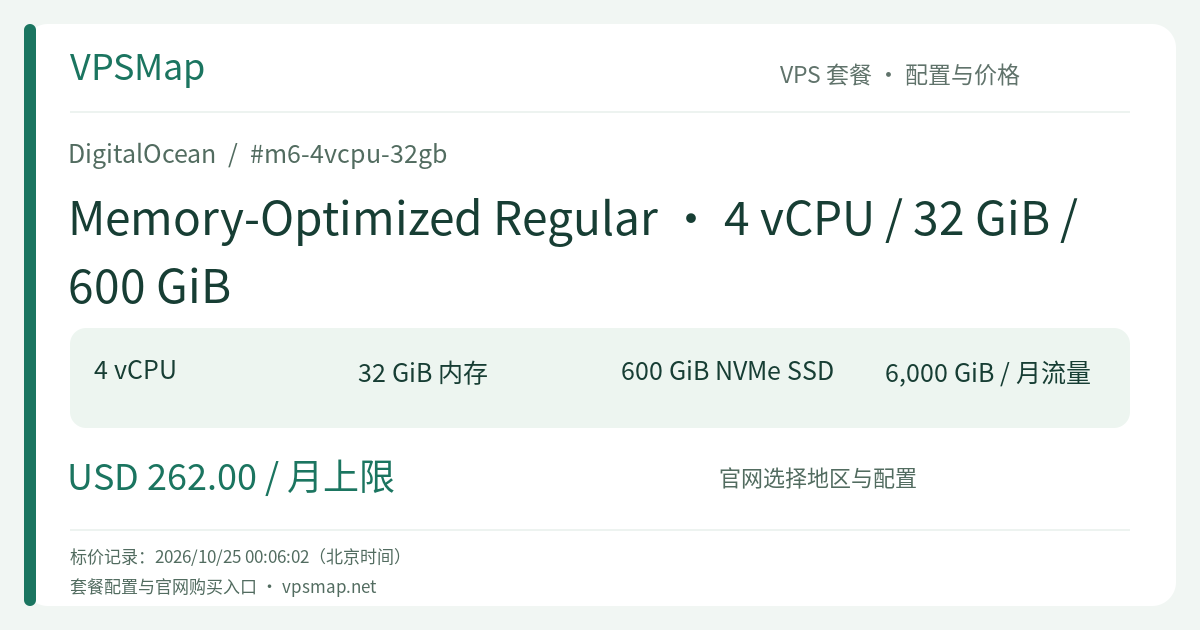
DigitalOcean m6-4vcpu-32gb In-Depth Review: 600 GiB Extreme Local NVMe and 32 GiB RAM for Heavy Data Workloads
Updated
The Dilemma of Heavy Persistence Under Strict Latency Demands#
High-throughput production architectures often collide with a frustrating infrastructural roadblock:
- The application manages hundreds of gigabytes of active operational data and historical records;
- End-to-end P99 response latencies must remain reliably below 10 milliseconds;
- Ingestion pipelines run continuously alongside extensive random indexing and full-dataset querying.
Deploying conventional architectures—such as standard virtual machines connected to 500+ GiB network storage volumes—frequently leads to I/O throttling. As query volume surges, software-defined network storage limits trigger rising disk queues, thread contention, and slow-query log spikes.
The only definitive solution is direct physical attachment: placing dense, high-speed NVMe solid-state storage directly onto the hypervisor's PCIe bus, establishing direct hardware pipelines between CPU, RAM, and disk.
The DigitalOcean Memory-Optimized Regular · 4 vCPU / 32 GiB / 600 GiB plan (m6-4vcpu-32gb) represents the pinnacle of this approach. Pairing 4 dedicated compute cores and 32 GiB of dedicated RAM with an enormous 600 GiB local NVMe SSD, this Droplet acts as a high-density, low-latency data fortress.
Hardware Capabilities and Architectural Payoffs#
1. 600 GiB Direct-Attached NVMe: Full Autonomy from External Volumes#
Expanding local NVMe capacity to 600 GiB—six times the baseline allocation—transforms single-node data capacities:
- Hosting Large Datasets Locally: Manage active databases between 300 and 500 GiB without resorting to premature database sharding or complicated tiered storage layers.
- Absorbing Sustained I/O Surges: Direct bus attachment delivers maximum parallel bandwidth. Nightly batch ETL routines, broad analytical queries, and table rebuilds run with massive throughput without impacting customer-facing queries.
- True Sub-Millisecond Transaction Commit: Critical
fsynccalls complete directly on local physical NVMe hardware, eliminating the latency jitters inherent in network-attached storage.
2. Dedicated Quad Cores with 32 GiB Memory Synergy#
- Extensive In-Memory Buffer Shield: Allocate 20+ GiB directly to database buffer pools or search engine heaps, reserving the remaining 10+ GiB for OS Page Cache to maximize in-memory read hits.
- Dedicated Execution Cores: 4 isolated hardware hyper-threads ensure that continuous background maintenance (such as Lucene segment merges or vacuuming routines) does not starve active API threads of compute power.
Primary Production Deployments#
- Large-Scale Search Nodes: Run high-density Elasticsearch, OpenSearch, or Solr nodes storing comprehensive catalog indexes and log archives on 600 GiB of local NVMe for sub-second search responses.
- Persistent Event and Stream Processing: Anchor Kafka, Redpanda, or Pulsar message brokers with multi-week message retention windows, supporting extensive replay routines without performance degradation.
- Consolidated Enterprise Database Primaries: Power primary PostgreSQL or MySQL instances managing extensive historical transactions, billing tables, and relational graphs with expansive headroom.
Operational Best Practices#
- Disaster Recovery Topologies: Because the 600 GiB disk is attached directly to the physical host, combine local performance with automated daily snapshot policies or export periodic logical dumps to S3-compatible DigitalOcean Spaces object storage.
- Resource Monitoring: Track CPU utilization during peak processing. If complex analytical queries push dedicated cores above 85% sustained utilization, introduce read replicas across your private network to distribute load.
Fleet Networking and Bandwidth Economics#
The Droplet includes a 2 Gbps network link and contributes 6,000 GiB of outbound transfer to your team's collective bandwidth pool, with all incoming transfer completely unmetered. Bandwidth pooling automatically offsets surges with unused capacity across other team instances, while unmetered internal VPC traffic ensures high-throughput communication with frontend services at zero additional cost.
To equip your infrastructure with an uncompromising 600 GiB direct NVMe storage powerhouse, you can deploy this instance on DigitalOcean.