DigitalOcean 2 vCPU / 8 GiB Premium AMD Guide: High-Memory Power for Caching, Data, and JVM Workloads
Updated
Overcoming the High-RAM Core-Bundling Tax#
In standard cloud server pricing, developers frequently run into an artificial pricing barrier: their application is memory-hungry, yet light on overall CPU utilization. In many conventional virtual machine catalogs, acquiring 8 GiB of RAM requires paying for 4 or even 8 CPU cores that sit mostly idle, artificially driving up monthly infrastructure bills.
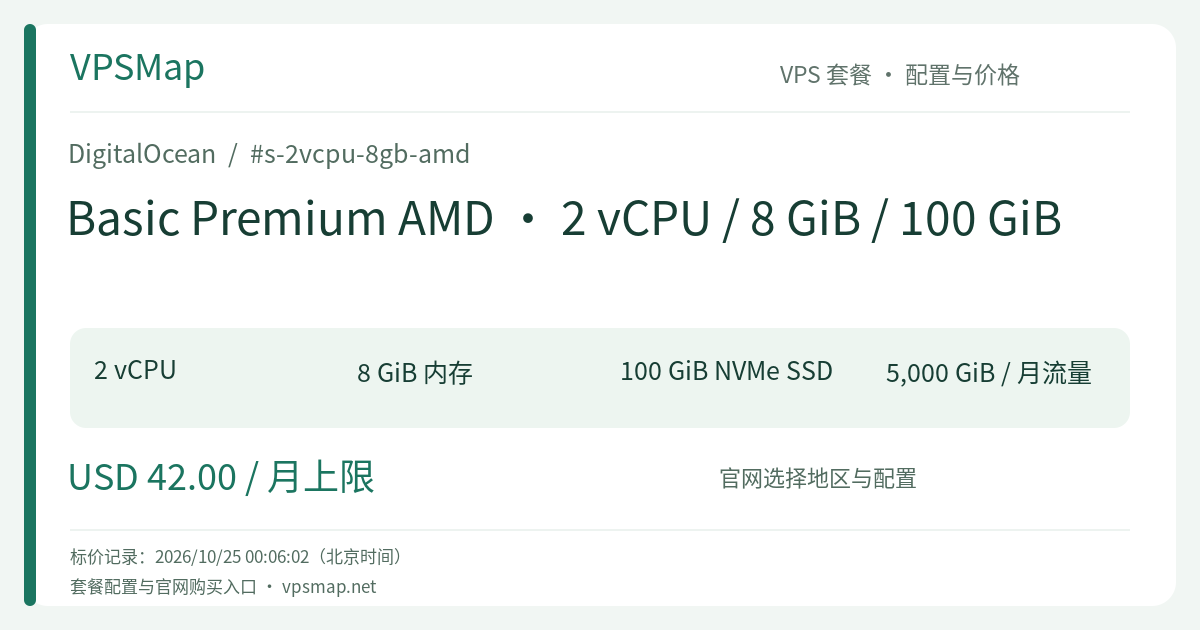
DigitalOcean's Basic Premium AMD 2 vCPU / 8 GiB Droplet (slug s-2vcpu-8gb-amd) is specifically engineered to break this restrictive bundling. It delivers a generous 8 GiB of 3,200 MHz high-frequency RAM, backed by 2 shared AMD EPYC cores and 100 GiB of fast NVMe solid-state storage at a predictable, cost-effective monthly cap. For memory-intensive workloads with moderate CPU demands, it is one of the most cost-efficient compute profiles on the market.
What Real Problems Does It Solve? Practical Use Cases#
1. Java and Kotlin (Spring Boot / Quarkus) Enterprise Microservices#
JVM-based applications have non-negotiable memory footprints. When constrained to 2 GiB or 4 GiB instances, the JVM frequently triggers intrusive Garbage Collection (GC) pauses, causing latency spikes and occasional out-of-memory crashes. An 8 GiB memory budget allows you to allocate 4–5 GiB directly to the heap while leaving abundant room for off-heap buffers and OS processes, maintaining smooth, deterministic response times.
2. High-Capacity Caching and Standalone Search Clusters#
- Redis / KeyDB In-Memory Caching: Function as a centralized caching tier for multi-node web architectures, housing millions of session keys and query result sets without triggering aggressive eviction policies.
- Elasticsearch / OpenSearch Nodes: Full-text search and indexing engines rely heavily on the underlying OS file cache. With 8 GiB of RAM, Lucene segments remain resident in memory, providing lightning-fast full-text search performance.
3. Self-Hosted Team Collaboration Suites#
- GitLab CE: The official hardware recommendation for GitLab Community Edition is a minimum of 4–8 GiB of RAM. This Droplet effortlessly supports the entire GitLab stack—including Puma, Sidekiq, Gitaly, and integrated PostgreSQL—supporting development teams with dependable source control and CI coordination.
- Business Intelligence & Analytics Hubs: Run data platforms like Metabase, Apache Superset, or internal reporting tools. These engines pull aggregate data directly into memory, delivering interactive dashboards without lag.
Hardware Advantage & Architectural Considerations#
- 3,200 MHz RAM Efficiency: For memory-bound applications, memory bus speed directly dictates overall transaction speed. High-frequency 3,200 MHz memory ensures low memory access latency for concurrent database queries and heap allocations.
- 100 GiB Local NVMe Headroom: The generous 100 GiB NVMe boot disk accommodates sizable database dumps, GitLab repositories, and search indices locally without requiring supplementary block storage volumes.
- Understanding the 2-Core Boundary: This plan is fundamentally an economic solution for high memory demands. If your workload requires both 8 GiB of RAM and persistent, heavy multi-core computation around the clock (such as continuous high-bitrate video encoding or parallel ML model training), the 2 shared cores may become a constraint. For those scenarios, evaluate Dedicated Memory-Optimized Droplets instead.
Flexible Billing & Network Transfer Value#
- Per-Second Billing Flexibility: Billed per second at roughly $0.0625/hour, capped at 672 hours ($42/month). Launch on demand for temporary database restorations, index rebuilding, or staging validations, and destroy the instance when complete to stop billing.
- 5,000 GiB Pooled Transfer Quota: The 5,000 GiB outbound bandwidth allowance accrues continuously and pools into your team's total bandwidth pool. Inbound traffic is free, and private intra-VPC communication carries zero network charges.
- Automated Incremental Backups: Guard business data with optional automated backups (weekly retention at 20% of Droplet cost; daily retention at 30%) with rapid incremental snapshots.
Summary & Getting Started#
DigitalOcean's s-2vcpu-8gb-amd Droplet fills an essential gap for developers and teams seeking generous memory without being forced into expensive multi-core tiers. It is an exceptional foundation for JVM microservices, caching layers, and self-hosted engineering platforms.
To confirm live datacenter capacity and provision your Droplet, head directly to the DigitalOcean Console.