DigitalOcean 4 vCPU / 8 GiB Premium AMD Droplet Review: The Sweet Spot for Full-Stack Production Workloads
Updated
The 4 vCPU / 8 GiB Milestone in Production Architecture#
When planning cloud infrastructure, developers often face an awkward dilemma: entry-level 1-2 vCPU VMs struggle under composite production stacks, while dedicated-CPU instances carry a substantial price jump that may be hard to justify for bursty, emerging workloads. When traffic spikes hit, a 1-core or 2-core node running both an application and a database frequently hits 100% CPU utilization, causing requests to queue up and latency to skyrocket.
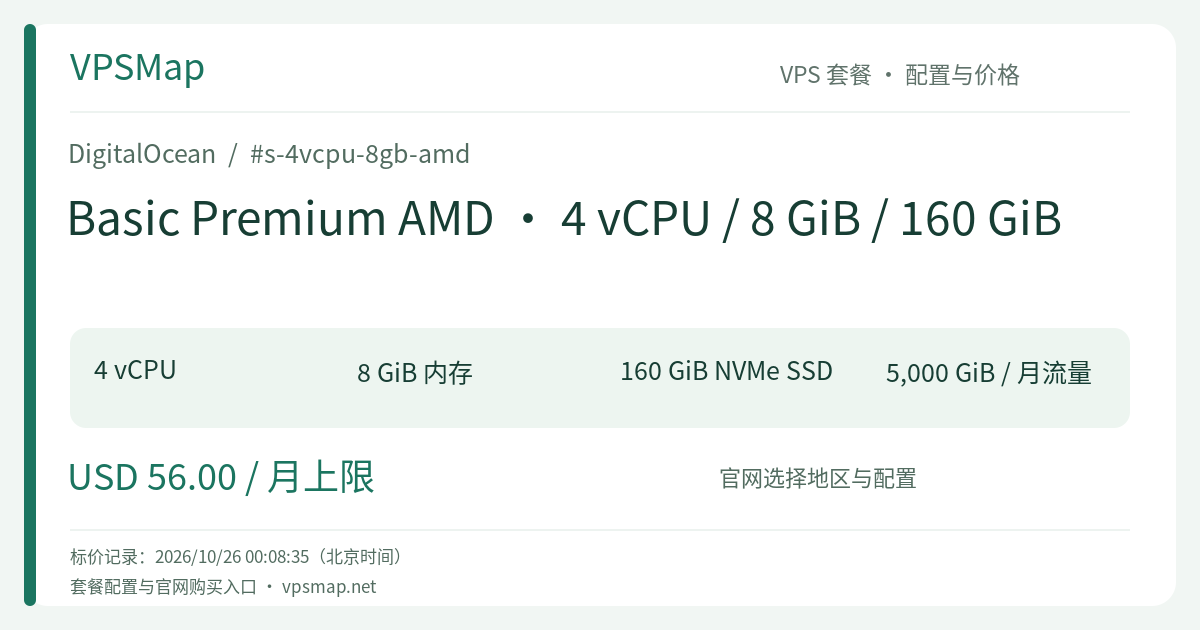
The DigitalOcean Basic Premium AMD · 4 vCPU / 8 GiB / 160 GiB instance (s-4vcpu-8gb-amd) occupies the optimal middle tier. With its balanced 1:2 compute-to-memory ratio, modern AMD EPYC architecture, and high-speed NVMe storage, it delivers the headroom required to run complete full-stack services without paying dedicated-hardware premiums.
Hardware Foundations: AMD EPYC & 3200 MHz Memory#
Compared to legacy Regular CPU tiers that rely on older processor generations and standard SSDs, the Premium AMD line provides tangible advantages across raw compute and disk latency:
- 2nd / 3rd Generation AMD EPYC Cores: Exceptional single-core IPC and robust multi-threading efficiency allow high-concurrency runtimes—such as Node.js cluster processes, Python ASGI/WSGI workers, PHP-FPM pools, and Go goroutines—to chew through requests rapidly and return to idle state.
- 3200 MHz Memory Frequency: Crucial for in-memory operations like Redis lookups, PostgreSQL hash joins, and dynamic runtime execution where memory throughput directly impacts tail latencies.
- 160 GiB Local NVMe Storage: Native NVMe takes advantage of deep hardware queue parallelism, ensuring that rapid transactional database commits and container image layers do not choke under sudden I/O spikes.
High-Value Workloads and Architecture#
This Droplet configuration is purpose-built for scenarios where multi-core execution and reliable memory boundaries matter:
1. All-in-One Docker Production Stack#
For teams that want operational simplicity without managing complex distributed clusters, this instance can comfortably host:
- Ingress Proxy: Nginx or Caddy managing TLS termination, HTTP/2/3, and edge compression.
- Application Runtime: Modern backend APIs running across multiple worker threads.
- Relational Storage: PostgreSQL or MySQL allocated a solid 2–3 GiB buffer pool for hot tables and indices.
- Task Queue & Cache: Redis or KeyDB managing background job queues (Sidekiq, Celery, BullMQ).
2. High-Traffic CMS & E-Commerce Platforms#
Complex WordPress, WooCommerce, or headless CMS platforms with extensive plugins frequently suffer from CPU starvation during checkout flows or administrative dashboard operations. Four EPYC cores process simultaneous PHP/database queries smoothly, while 8 GiB of RAM accommodates generous OPcache and database buffer allocations.
3. CI/CD Runners & Parallel Build Agents#
Self-hosted GitHub Actions or GitLab CI runners require multi-threaded power to compile TypeScript, build Docker images, and run parallel automated test suites. The 4 EPYC cores speed up compilation runs, while 160 GiB of fast local NVMe provides ample headroom for Docker cache layers.
Architectural Trade-Offs: The Shared CPU Reality#
It is important to understand where the Basic Droplet tier fits within cloud virtualization:
- Hypervisor Dynamism: Shared vCPUs allow your virtual machine to burst and access hyper-threads as needed. Under ordinary traffic conditions with intermittent spikes, this model yields the highest compute value per dollar.
- When to Choose Dedicated Instead: If your application generates a sustained, flatline 100% CPU load around the clock (e.g., continuous video transcoding, intensive cryptographic computations, or real-time high-frequency trading), neighbors on the physical host can lead to resource throttling. In such scenarios, consider upgrading to DigitalOcean’s General Purpose or CPU-Optimized dedicated tiers.
Transparent Billing and Bandwidth Pooling#
DigitalOcean simplifies operating costs with developer-friendly billing policies:
- Per-Second Billing with Monthly Cap: Monthly charges are capped at 672 hours (28 days). If spun up for staging, stress testing, or short campaigns, you only pay for the exact seconds the Droplet exists.
- 5,000 GiB Pooled Outbound Bandwidth: Inbound bandwidth is completely free. The generous 5,000 GiB outbound allowance is pooled at the team level, meaning transfer bandwidth is shared across all active Droplets on your account. Private communication across DigitalOcean VPCs is free and does not deplete your quota.
- Effortless Disaster Recovery: Automated incremental backups can be enabled weekly (20% of Droplet cost) or daily (30% of Droplet cost) for hands-off data protection.
Deployment Verdict#
For growing projects graduating from small side setups into dependable commercial systems, the 4 vCPU / 8 GiB AMD Droplet delivers the performance cushion necessary to maintain fast response times and handle unexpected traffic surges.
Notice: Hardware capacity and regional availability are confirmed within the cloud console during provisioning. Choose the datacenter closest to your primary user base to minimize network latency.