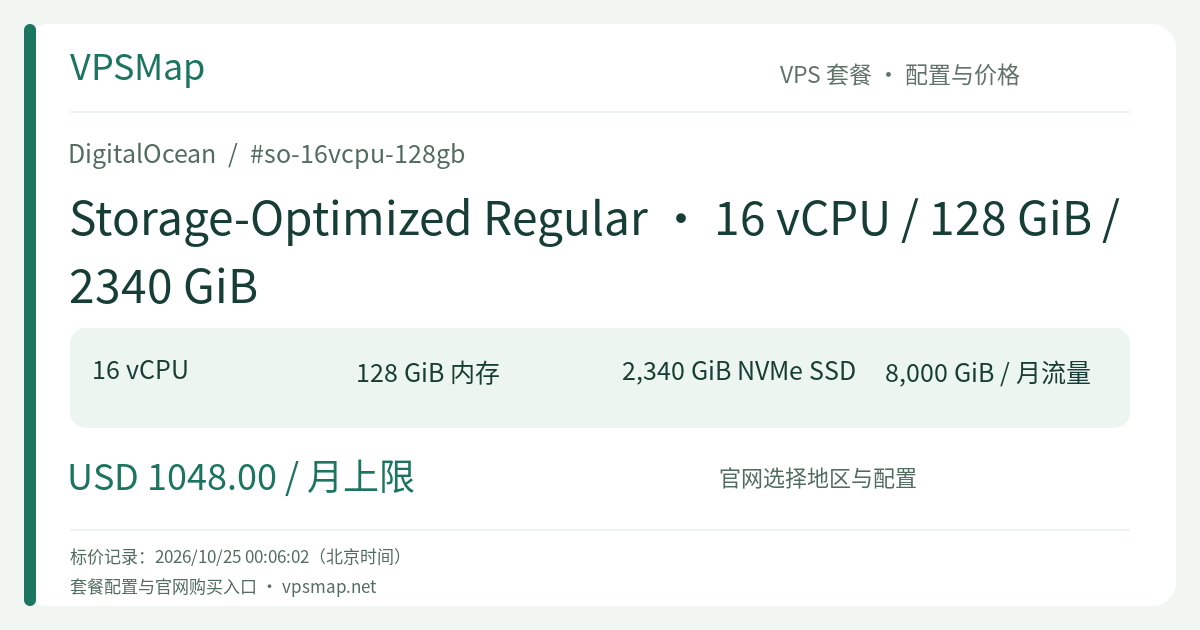
DigitalOcean Storage-Optimized 16 vCPU / 128 GiB Guide: Heavy-Duty Local NVMe for High-Throughput Databases and Search Clusters
Updated
Why Standard Cloud VMs Hit Storage Bottlenecks Under Pressure#
Many engineering teams encounter a frustrating performance plateau during rapid scaling: CPU utilization remains moderate, RAM appears sufficient, but application latency spikes and database queries back up into dangerous connection queues. The culprit is almost always disk I/O.
In standard cloud architectures, virtual machine storage typically relies on network-attached block storage. While convenient for detachment and snapshotting, every read and write must traverse a virtualized storage layer and the physical datacenter network fabric. Under sustained write pressure, heavy index compaction, or complex parallel scans, the latency hops and strict IOPS/throughput rate limits imposed on network volumes quickly choke your throughput.
To solve this exact bottleneck, DigitalOcean offers the Storage-Optimized Droplet family. The so-16vcpu-128gb plan breaks free from remote storage constraints by providing 2340 GiB (~2.34 TB) of enterprise NVMe SSD directly attached to the hypervisor bus. Without network encapsulation or remote congestion, I/O requests reach the flash media at physical bus speeds with sub-millisecond latencies.
The Hardware Balance: 16 Dedicated Cores, 128 GiB RAM, and 1:8 Ratio#
Raw disk size means little if compute and memory cannot keep pace. This configuration is built with a carefully balanced 1:8 resource ratio:
- True Dedicated vCPUs (16 Cores) Unlike shared CPU plans where hyper-threads are dynamically allocated among noisy neighbors, these 16 dedicated vCPUs grant 100% exclusive access to the underlying hardware execution threads. Compute-intensive tasks—such as LSM-tree compactions in RocksDB/Cassandra or complex query planning in PostgreSQL—will never suffer from CPU steal or unpredictable scheduling jitter.
- Generous 128 GiB Memory Pool
At 8 GiB of RAM per vCPU, this tier unlocks massive headroom for critical state engines:
- Relational Databases (MySQL / PostgreSQL): Keep massive active working datasets inside
innodb_buffer_poolor shared buffers, turning disk reads into lightning-fast memory hits and reserving disk writes for sequential write-ahead logs (WAL). - Elasticsearch & OpenSearch: Follow production best practices by dedicating ~31 GiB to the JVM heap for rich query executions and inverted index operations, leaving the remaining 90+ GiB entirely to the Linux kernel Page Cache for rapid Lucene segment lookups.
- Relational Databases (MySQL / PostgreSQL): Keep massive active working datasets inside
- 2340 GiB Direct-Attached NVMe Representing the 1X storage variant (~146 GiB per dedicated vCPU), this 2.34 TB footprint provides substantial capacity for growing transaction histories, large indexes, and temporary scratch tables without requiring auxiliary block storage.
Ideal Production Workloads#
This configuration represents an exceptional performance-to-cost ratio for several demanding infrastructure roles:
- Distributed Search Clusters (Elasticsearch, OpenSearch, Solr) Handling thousands of indexing requests per second alongside heavy analytical aggregations. Direct NVMe prevents cluster-crippling indexing queues and yellow/red cluster states caused by slow I/O flushes.
- High-Throughput NoSQL Stores (MongoDB, Cassandra, ScyllaDB) Ideal for write-heavy applications like analytics ingestion, telemetry, and social feeds. Direct-attached flash eliminates latency spikes during checkpointing and database background compactions.
- Core Relational Primaries (PostgreSQL, MySQL)
For busy transactional workloads where disk
fsyncoperations dictate maximum transaction-per-second (TPS) throughput. - Message Brokers and Event Streams (Apache Kafka, Redpanda) Leverage 128 GiB of memory for high-performance zero-copy page caching while streaming millions of events sequentially to local NVMe storage.
Architectural Trade-offs and Best Practices#
Achieving physical bus I/O performance requires understanding the inherent operational trade-offs:
Key Architectural Consideration: Application-Level High Availability Because storage is physically tied to the underlying hypervisor host, an unexpected physical hardware failure means the storage volume cannot simply be hot-attached to another hypervisor. For production reliability, always architect with distributed redundancy:
- Deploy database clusters with automated replication and failover (e.g., MongoDB Replica Sets, PostgreSQL streaming replication with Patroni, or multi-node Elasticsearch).
- Implement regular backup pipelines. DigitalOcean provides automated incremental backups (daily backups cost 30% of the Droplet monthly cost; weekly backups cost 20%), or you can leverage SnapShooter and Spaces object storage for custom schedules.
On the networking side, this Droplet includes a 2000 Mbps interface and an 8000 GiB outbound data transfer pool (inbound is completely free). Cross-Droplet private traffic inside your Virtual Private Cloud (VPC) is unmetered and free, allowing you to isolate this data powerhouse securely behind your application tier.
Billing and Next Steps#
This plan features transparent and predictable pricing: billed per second at approximately $1.55952 per hour, capped at $1048.00 per month (based on 672 hours / 28 days; running continuously past 28 days incurs no further hourly charges for that billing cycle).
Whether deployed as a permanent production anchor or spun up for transient big-data batch processing, it delivers uncompromising throughput on demand. You can provision your node directly within the DigitalOcean Console.