Evoxt Premium VM-4 Deep Dive: 4 Cores, 8GB RAM Production Workhorse on Hong Kong & Osaka Premium Networks
Updated
When a software project transitions from initial MVP testing to production deployment, infrastructure bottlenecks almost invariably hit memory and disk ceilings first. A 2GB or 4GB droplet can easily trigger out-of-memory kernel panics when handling concurrent database sessions, log spikes, or multiple container layers.
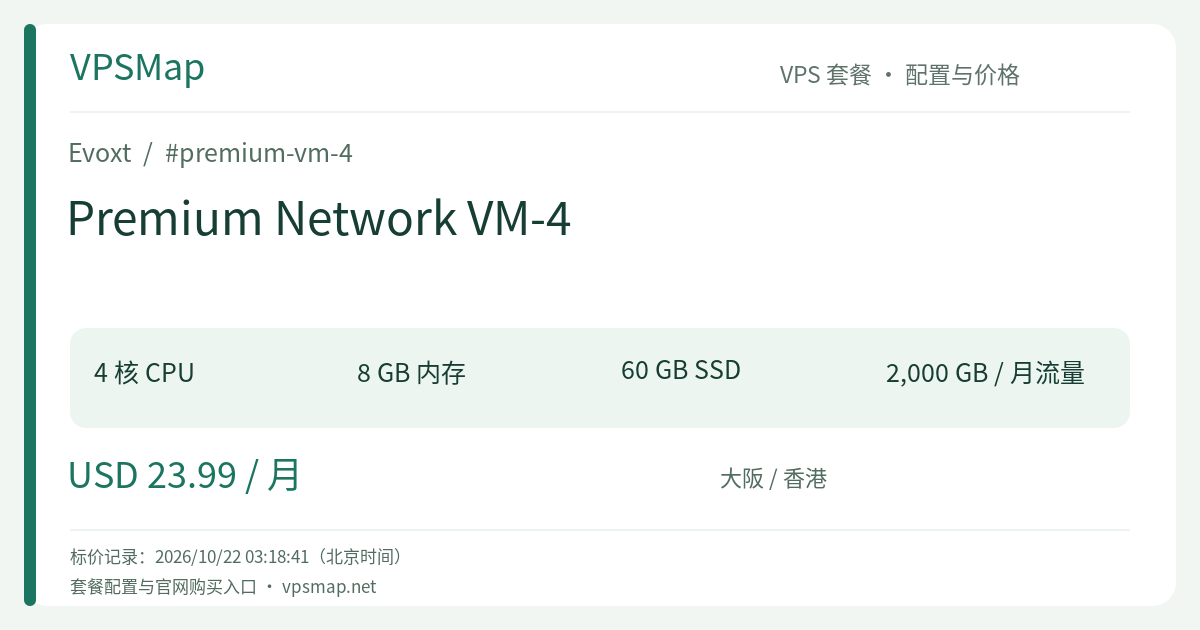
The Evoxt Premium Network VM-4 is engineered explicitly as a robust production workhorse. At $23.99 / month, it pairs 4 high-frequency vCPUs (up to 6.0 GHz Turbo) with 8GB RAM, 60GB NVMe storage, and a generous 2000GB (2TB) premium monthly bandwidth envelope. Deployed across Hong Kong CN2 and Osaka backbones, it delivers the stability and responsiveness enterprise operations require.
Detailed Hardware & Network Architecture#
| Specification | Allocation Details | Production Advantage |
|---|---|---|
| Processor (CPU) | 4 vCPUs (Up to 6.0 GHz Turbo) | Swift thread handling, preventing request queuing during traffic surges |
| System Memory | 8192 MB (8 GB RAM) | Ample breathing room to eliminate Linux OOM hazards |
| Storage Disk | 60 GB High-Speed NVMe | Room for Docker image caches, persistent databases, and historical logs |
| Monthly Traffic | 2000 GB (2 TB) / month | 1 Gbps port on premium transit networks |
| Network Zones | Hong Kong (CN2) / Japan (Osaka) | Ultra-low packet loss and deterministic routing to East Asia |
| Data Redundancy | Free Weekly Offsite Backups | Platform-level scheduled backup snapshots with zero addon cost |
| Base Pricing | $23.99 / month | Available on monthly to 3-year billing intervals with modular upgrades |
The Operational Advantage of 8GB RAM#
For professional production systems, 4GB is merely acceptable, while 8GB represents true operational resilience:
- Room for Modern Docker Compose Stacks: A typical production micro-architecture includes an edge reverse proxy (Nginx or Caddy), backend services (Go, Node.js, or Python), database instances (PostgreSQL or MariaDB), caching tiers (Redis), and background task runners. An 8GB ceiling ensures this stack functions comfortably without resource starvation.
- Database Cache Optimization: RDBMS engines thrive on RAM. On VM-4, you can allocate 2GB to 4GB directly to the InnoDB buffer pool or shared buffers, keeping relational indices and hot tables residing entirely in volatile memory for near-zero read latency.
- Comfortable 60GB Disk Space: Unlike modest 20GB-30GB system disks where Docker build caches quickly trigger disk-full warnings, 60GB provides sufficient headroom for daily operation without manual weekly disk pruning.
High-Value Regional Routing#
Under the Premium Network designation, VM-4 provides two critical Asian locations:
- Hong Kong (CN2 Direct Peering): Website conversion rates are directly correlated with latency. The Hong Kong cluster offers direct low-latency transit into mainland China via CN2 routing, granting cross-border platforms sub-50ms ping times to southern coastal cities without requiring domestic business licenses.
- Osaka, Japan (Softbank & BBIX): Relying on Softbank transit alongside BBIX and JPIX exchanges, the Osaka deployment ensures pristine network conditions for audiences across Japan, Korea, and Taiwan, maintaining consistent throughput.
2,000GB of premium monthly traffic is ample for dynamic websites, easily handling substantial monthly pageviews even on resource-dense layouts.
Practical Tier Comparisons: Where Does VM-4 Fit?#
- VM-4 vs. VM-3 ($14.99 / mo): For an extra $9.00 / month, the VM-4 doubles your RAM (from 4GB to 8GB), doubles your SSD storage (from 30GB to 60GB), and doubles your monthly transfer (from 1000GB to 2000GB). If you are serving real clients or processing commercial orders, this $9 delivers substantial insurance against downtime.
- VM-4 vs. VM-6 ($29.99 / mo): The VM-6 plan costs $6 more per month and jumps from 4 to 8 CPU cores while keeping RAM at 8GB and storage at 60GB. Unless your specific workload is pure parallel compute (such as video batch processing or heavy automated web scrapers), 4 cores clocked up to 6.0 GHz are more than enough to saturate 8GB of memory. VM-4 remains the smarter everyday choice.
Recommended Use Cases#
- E-Commerce & High-Traffic CMS: Production Magento, WooCommerce, or Prestashop installations requiring fast database transactions.
- Self-Hosted Development Infrastructure: GitLab Community Edition, Gitea runners, or Nextcloud corporate document repositories.
- API Backends & Microservice Clusters: Node.js/TypeScript, Go, or Python FastAPI backends paired with Redis caching and relational databases.
- Production Web Application Proxies: Reverse proxies handling TLS termination, basic rate limiting, and cross-border edge acceleration.
How to Order and Deploy#
- Visit the Portal: Access the Evoxt Official Console.
- Select Regional Datacenter: Choose Hong Kong or Japan (Osaka) under the Premium Network options.
- Choose Instance Tier: Select the VM-4 tier (4 Cores / 8 GB RAM / 60 GB NVMe / 2000 GB Transfer).
- Pick Image or 1-Click Application: Choose standard Linux distributions (Ubuntu, Debian, AlmaLinux, Rocky) or select pre-configured stacks like Docker, OpenLiteSpeed, CyberPanel, or WordPress.
- Complete Checkout: Select your billing period (monthly up to 3 years) and finalize payment via Credit Card, PayPal, Bitcoin, or USDT (Tron). The instance deploys automatically within roughly 2.5 minutes.