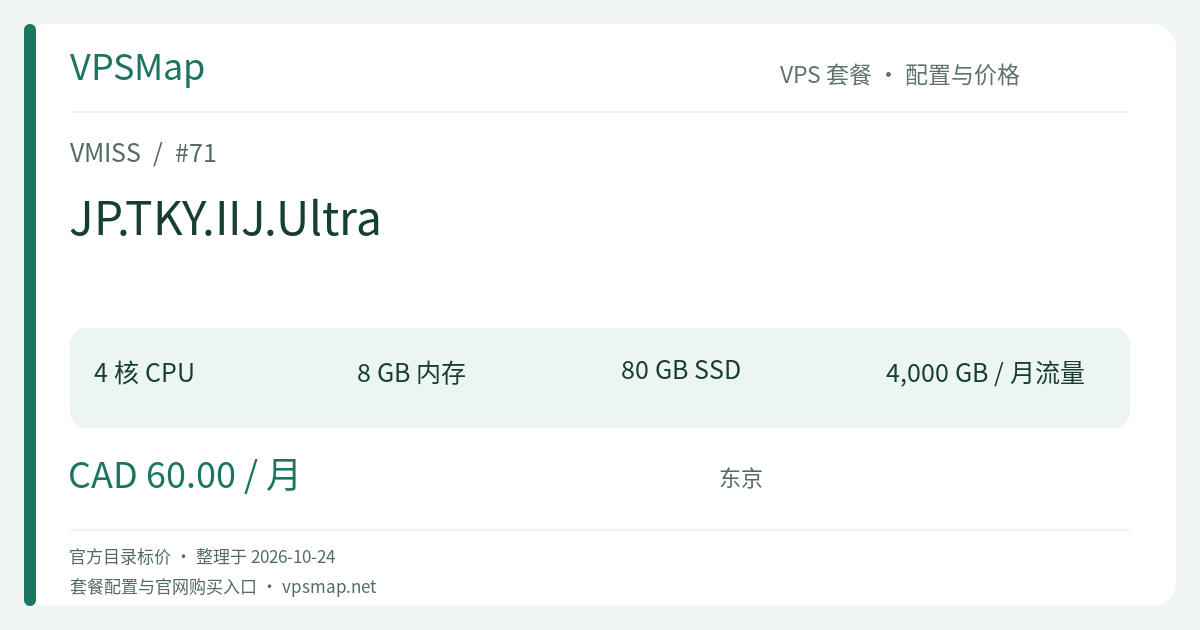
VMISS JP.TKY.IIJ.Ultra Review & Buyer's Guide: 4 Cores, 8GB RAM, and 1Gbps Flagship Tokyo Cloud Server
Updated
The Flagship Tier: When Do You Truly Need 4 Cores, 8GB RAM, and 1Gbps?#
When sizing cloud infrastructure, entry and intermediate workloads are usually well served by 1 or 2 CPU cores. However, demanding production environments often hit steep performance walls when forced into constrained environments:
- Heavy Enterprise Runtimes: Enterprise services built on Java (Spring Boot), .NET, or modular Ruby on Rails require gigabytes of dedicated memory simply to handle runtime initialization, thread pools, and garbage collection without latency spikes;
- High-Throughput Data Spikes: Under sudden surges of client traffic, 500Mbps or 750Mbps ports can saturate in seconds, causing network packet queuing and dropped connections;
- Multi-Tenant Data Aggregation: Running search indexing (Elasticsearch/OpenSearch), automated log processing, and real-time API dispatching concurrently on a single machine requires significant CPU parallelism and memory capacity.
VMISS JP.TKY.IIJ.Ultra was engineered specifically to eliminate these bottlenecks. Equipped with 4 vCPUs, 8192 MB (8 GB) RAM, and 80 GB of local storage, it is the only plan in the Tokyo IIJ lineup that features an uncapped 1000 Mbps (1 Gbps) network port. It stands ready as an enterprise-grade cloud server capable of handling sustained, high-load operations in Tokyo.
Hardware and Network Specifications#
| Specification | Details |
|---|---|
| vCPU Cores | 4 vCPUs |
| System Memory | 8192 MB (8 GB) |
| Local Storage | 80 GB |
| Monthly Bandwidth | 4000 GB |
| Port Speed | 1000 Mbps (1 Gbps) |
| Datacenter / Network Tag | Tokyo, Japan / JP.TKY.IIJ |
| Official Price | CAD 60 / month (Billed in Canadian Dollars) |
| Purchase Link | Order VMISS JP.TKY.IIJ.Ultra |
Compared to other tiers in this product line, Ultra delivers distinct structural advantages:
- Full 1000 Mbps Port Capacity: While lower tiers operate on 500Mbps or 750Mbps ports, Ultra exclusively unlocks the full 1Gbps uplink for maximum burst capability.
- 4000 GB Monthly Bandwidth: Providing an average of roughly 133 GB per day, accommodating high-volume API payloads and heavy web traffic.
- 80 GB Storage Foundation: Delivers comfortable capacity for persistent database storage, local Docker build layers, and rolling application backups.
High-Impact Workload Scenarios#
- Enterprise Microservices and JVM Environments Safely allocate 4GB to 5GB of heap memory to Java/Kotlin/Scala backends while retaining sufficient overhead for system caching, Prometheus monitoring exporters, and reverse proxies without triggering GC freezes.
- High-Throughput API Gateway and Regional Relays Leverage 4-core concurrency and 1Gbps networking to process high-frequency cross-border transactions and API load balancing across East Asia with minimal latency.
- All-in-One Self-Hosted Collaboration Platforms Run demanding integrated platforms such as a full GitLab Community Edition instance alongside its database, Redis queue, and CI runner ecosystem on a single reliable host.
Critical Trade-offs and Official Policy Guidelines#
When deploying on this flagship tier, keep the following official terms in mind:
- IPv4-Only Networking (No IPv6): According to the official VMISS announcement on June 8, 2026, IPv6 service on the JP.TKY.IIJ line has been discontinued. This instance comes equipped with a single public IPv4 address. IPv6 client access should be handled via an upstream CDN or dual-stack gateway.
- Network Categorization: The "IIJ" nomenclature is the provider's product group designation. Official documentation does not guarantee custom routing rules per individual ISP.
- IP Replacement Procedure: If an IP rotation is required during service, VMISS provides an IP Replacement add-on for CAD 5. Once purchased, submit a support ticket referencing the service instance to complete the swap.
- Budget Alignment: At CAD 60/month, this plan represents a dedicated production investment. Ensure your concurrency requirements and memory profiles genuinely justify this tier over intermediate plans.
Full Series Comparison: The Case for Ultra#
| Plan Name | vCPU / RAM | Storage | Bandwidth | Port Speed | Price |
|---|---|---|---|---|---|
| JP.TKY.IIJ.Basic | 1C / 1024 MB | 10 GB | 500 GB | 500 Mbps | CAD 5 / mo |
| JP.TKY.IIJ.Core | 1C / 1024 MB | 15 GB | 800 GB | 500 Mbps | CAD 10 / mo |
| JP.TKY.IIJ.Pro | 1C / 2048 MB | 20 GB | 1500 GB | 750 Mbps | CAD 16 / mo |
| JP.TKY.IIJ.Elite | 2C / 4096 MB | 40 GB | 2500 GB | 750 Mbps | CAD 30 / mo |
| JP.TKY.IIJ.Ultra | 4C / 8192 MB | 80 GB | 4000 GB | 1000 Mbps | CAD 60 / mo |
- Why Step Up from Elite (CAD 30/mo) to Ultra (CAD 60/mo): Elite (2 Cores / 4GB RAM / 750Mbps) serves standard production needs well. However, when peak CPU utilization consistently crosses 80%, or memory consumption limits database cache growth, Ultra doubles all primary computing dimensions—providing 4 cores, 8GB RAM, 80GB storage, and a wider 1Gbps pipe. Doubling the infrastructure investment here buys direct resilience against production outages during critical traffic events.
Kernel and Performance Tuning Guidelines#
To fully exploit 4 cores, 8GB RAM, and 1Gbps connectivity, consider applying these performance tuning parameters upon deployment:
- Optimize Network Kernel Parameters (for 1Gbps High Concurrency): Append the following settings to
/etc/sysctl.conf:Apply withnet.core.somaxconn = 65535 net.ipv4.tcp_max_syn_backlog = 8192 net.core.netdev_max_backlog = 16384 net.ipv4.tcp_rmem = 4096 87380 16777216 net.ipv4.tcp_wmem = 4096 65536 16777216 net.ipv4.tcp_congestion_control = bbrsysctl -p. - Configure Memory Boundaries for Production Workloads:
- For Java microservices: Set
-Xms4g -Xmx4g, assigning 4GB to the JVM heap while leaving 4GB for OS file caching and background services. - For PostgreSQL databases: Set
shared_buffers = 2048MBandeffective_cache_size = 6144MBinpostgresql.conf.
- For Java microservices: Set
- Align Worker Processes: Configure Nginx with
worker_processes auto;and verify that worker processes spread evenly across all 4 vCPU cores.