VMISS US.LA.CMIN2.Ultra Deep Dive: 4 Cores, 8GB RAM, and 3,200GB Traffic for Consolidated Production Stacks
Updated
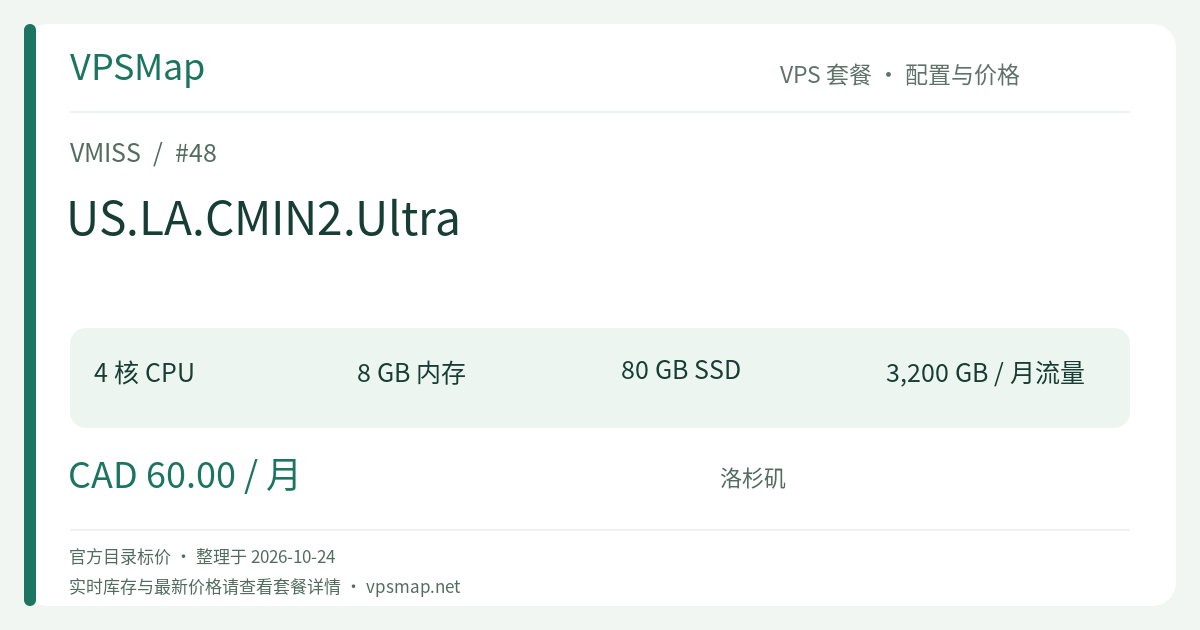
As overseas web architectures evolve beyond simple prototypes into multi-tiered ecosystems—incorporating microservices, dedicated databases, caching layers, and asynchronous task queues—infrastructure engineers face a fundamental decision: continue spinning up multiple low-spec VPS nodes, or consolidate everything onto a single, robust host. The US.LA.CMIN2.Ultra (PID 48) from VMISS is built specifically for consolidation. Delivering 4 CPU cores, 8192 MB (8GB) of RAM, 80GB of storage, and 3,200GB of monthly bandwidth on a 500Mbps port, it sits at the apex of the CMIN2 product line for CAD 60/month.
The Economics of Consolidation: Single Powerful Node vs. Fragmented Instances#
Managing multiple low-tier instances often seems economical at first glance: one CAD 10 server for an API, a CAD 16 server for a database, and a CAD 12 server for background workers. In practice, this architectural fragmentation introduces substantial hidden costs:
- Redundant Operating System Overhead: Every independent VPS consumes hundreds of megabytes of RAM running base system processes, systemd, SSH daemons, and monitoring agents. This overhead dilutes the actual usable memory across your infrastructure.
- Network Latency and Security Burden: Inter-service communication across distinct instances requires public routing or complex private tunnels. This introduces latency hops and demands meticulous maintenance of external firewall rules and credentials.
- Administrative Complexity: Applying security updates, renewing TLS certificates, and managing daily backups across multiple disconnected machines exponentially increases maintenance friction.
Consolidating onto US.LA.CMIN2.Ultra eliminates these pain points. With 4 cores and 8GB of RAM, you can leverage Docker Compose or Podman to host your web server, backend runtime, PostgreSQL/MySQL database, Redis cache, and Celery/RabbitMQ workers within a single internal Docker bridge network. Inter-service data flows with sub-millisecond, memory-speed latency, boosting responsiveness and streamlining administrative overhead.
Workloads Powered by 4 Cores, 8GB RAM, and 80GB Disk#
US.LA.CMIN2.Ultra provides the headroom necessary for demanding computing requirements:
- High-Traffic CMS and E-Commerce Platforms: Heavily customized WordPress / WooCommerce stores with Redis object caching, or self-hosted e-commerce backends. The 8GB RAM pool allows substantial allocation to PHP-FPM process pools and MySQL InnoDB buffer pools, handling traffic surges with minimal swapping.
- Continuous Integration and Task Runners: Perfect for teams running self-hosted GitLab Runners, Jenkins build nodes, or automated headless browser clusters (Puppeteer / Playwright). The 4 CPU cores ensure smooth parallel compilation and test execution.
- Analytics and Monitoring Stacks: Effortlessly host Prometheus, Grafana, and InfluxDB time-series engines, or lightweight Elasticsearch / OpenSearch nodes where memory-hungry JVM processes require guaranteed physical RAM to prevent crash loops.
Bandwidth Capacity: 3,200GB Quota and 500Mbps Port#
Network reliability and capacity are central to the Ultra specification. Assigned to VMISS's US.LA.CMIN2 Los Angeles routing tier, the server is backed by a 500Mbps burst port and an expansive 3,200GB (3.2TB) monthly transfer allowance.
- Over 100GB of Daily Transfer: High-frequency database replication, continuous log exports, and media distribution can run without the threat of hitting bandwidth caps mid-billing cycle.
- 500Mbps Burst Speed: Ensures your Los Angeles gateway transfers high-volume data streams quickly, preventing client-side connection congestion during peak operational hours.
Complete CMIN2 Tier Breakdown#
| Plan Name | CPU Cores | RAM | Storage | Monthly Traffic | Port Speed | Price |
|---|---|---|---|---|---|---|
| US.LA.CMIN2.Basic | 1 Core | 1024 MB | 10 GB | 400 GB | 200 Mbps | CAD 5 / mo |
| US.LA.CMIN2.Core | 1 Core | 1024 MB | 15 GB | 800 GB | 200 Mbps | CAD 10 / mo |
| US.LA.CMIN2.Pro | 1 Core | 2048 MB | 20 GB | 1200 GB | 300 Mbps | CAD 16 / mo |
| US.LA.CMIN2.Elite | 2 Cores | 4096 MB | 40 GB | 2000 GB | 500 Mbps | CAD 30 / mo |
| US.LA.CMIN2.Ultra | 4 Cores | 8192 MB | 80 GB | 3200 GB | 500 Mbps | CAD 60 / mo |
Compared to the mid-tier Elite plan, Ultra doubles CPU cores, doubles RAM capacity, and doubles local storage (from 2 cores to 4, 4GB to 8GB, and 40GB to 80GB), while increasing monthly transfer from 2,000GB to 3,200GB. This makes it an ideal fit for validated businesses and demanding production workloads that require substantial resources on a unified machine.
Deployment Guidelines & Policies#
- Storage Hygiene: 80GB of local SSD storage provides plenty of room for system libraries, container layers, and operational data. Implement automated pruning rules (such as
docker system prunecron jobs andjournalctlsize restrictions) to maintain healthy disk availability. - Network Routing Dynamics: The US.LA.CMIN2 designation reflects the vendor's Los Angeles route profile. End-to-end performance across public transpacific links remains dependent on wide-area carrier conditions.
- IP Replacement Policy: Should your deployment ever require a clean IPv4 assignment, VMISS provides an official IP Replacement add-on under their client portal (Store -> Others) for CAD 5. Once ordered, open a support ticket indicating the active service ID to complete the transition.
For engineers and operators looking to cut through multi-node clutter and power a serious application stack from a single Los Angeles hub, US.LA.CMIN2.Ultra provides the computing scale and network throughput required.