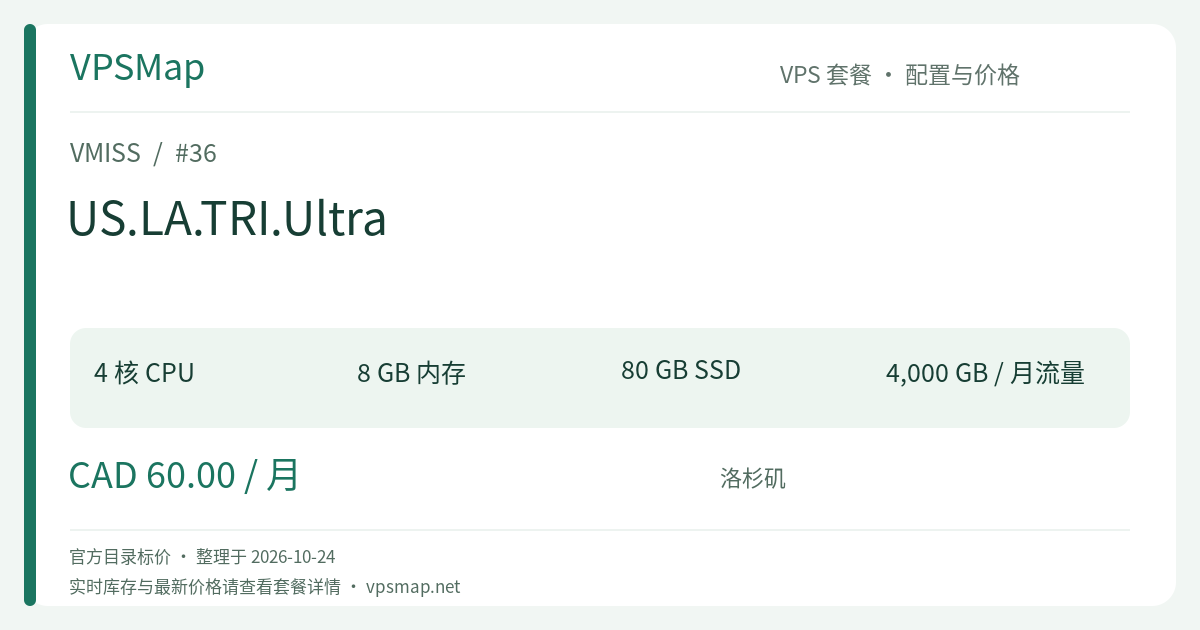
VMISS US.LA.TRI.Ultra Review: 4 vCPU, 8GB RAM, and 4TB Bandwidth for Demanding Deployments
Updated
When selecting overseas cloud infrastructure, growing teams and developers frequently struggle to balance the risks of memory exhaustion on entry-level VPS instances with the prohibitive cost of bare-metal dedicated servers. Within VMISS's Los Angeles TRI product lineup, the US.LA.TRI.Ultra plan serves as that critical bridge. Equipped with 4 vCPUs, 8GB of RAM, 80GB of storage, and a massive 4000GB (4TB) monthly bandwidth allocation, it provides a dependable environment for production tasks without forcing an early jump to dedicated hardware.
Priced at CAD 60 / month, this machine warrants a thorough breakdown. Understanding its capacity ceiling, practical operational fit, and trade-offs compared to the Pro and Elite tiers is essential for making an informed purchasing decision.
Specification Profile & Hardware Allocation#
US.LA.TRI.Ultra represents the top performance tier in VMISS's Los Angeles TRI group, featuring the following hardware specifications:
| Specification | Official Specification Value |
|---|---|
| vCPU | 4 Cores |
| RAM | 8192 MB (8 GB) |
| Storage | 80 GB |
| Monthly Traffic | 4000 GB (4 TB) |
| Port Bandwidth | 500 Mbps |
| Official Price | CAD 60 / month |
| Location & Network | US - Los Angeles (Tag: TRI) |
Compared to its smaller siblings, the Ultra plan doubles both compute and memory capacity while expanding network port throughput from 300Mbps up to 500Mbps. Paired with a 4TB data allowance, it handles compute-heavy workloads as comfortably as it handles sustained, data-intensive networking.
Practical Workload Fit: What Problems Does It Solve?#
1. Robust Multi-Container Stacks Free from OOM Crashes#
Modern application stacks rely heavily on microservices and containerization. If you run a Docker Compose environment combining Nginx/Caddy, a PostgreSQL or MySQL relational database, a Redis cache layer, and multiple backend runtimes (such as Node.js, Go, or Python):
- A 1GB or 2GB VPS frequently suffers from kernel OOM Killer interventions during image compilation or traffic spikes;
- A 4GB instance can survive regular operations, but offers minimal overhead for database index caching and burst allocations;
- US.LA.TRI.Ultra's 8GB of memory guarantees ample operating system page caching alongside primary application services, drastically improving uptime resilience.
2. Sustained Data Transfers with 130GB+ Daily Headroom#
A 4000GB monthly quota translates to approximately 133GB of clean data transfer allowance every day. Combined with 500Mbps burst port capacity, this setup suits:
- Cross-region automated backups: Acting as an offsite backup hub or snapshot repository receiving nightly archives from multiple satellites;
- Static asset distribution: Serving as a regional reverse-proxy cache to offload heavy outbound bandwidth from primary origin servers;
- API gateways and aggregation layers: Managing large volumes of serialized JSON requests without suffering internal socket bottlenecks on throttled 100M/200M pipes.
3. Compute Power for Self-Hosted CI/CD Runners#
Developers who maintain self-hosted build runners (such as GitLab Runner or Gitea Actions) need responsive multicore processing. The 4 vCPU cores allow concurrent compilation and test container execution, cutting build pipelines down significantly compared to entry-level single-core droplets.
Lineup Evaluation: Do You Truly Need the Ultra Plan?#
To ensure you are not over-provisioning unnecessarily, consider where your demands sit along the TRI family ladder:
| Plan Name | vCPU | RAM | Storage | Bandwidth | Port Speed | Price (CAD) | Best For |
|---|---|---|---|---|---|---|---|
| US.LA.TRI.Pro | 1 Core | 3084 MB | 20 GB | 1500 GB | 300 Mbps | 16 / mo | Single-service blogs, lightweight APIs, personal utilities |
| US.LA.TRI.Elite | 2 Cores | 4096 MB | 40 GB | 2500 GB | 300 Mbps | 30 / mo | Mainstream production sites, standard databases, moderate stacks |
| US.LA.TRI.Ultra | 4 Cores | 8192 MB | 80 GB | 4000 GB | 500 Mbps | 60 / mo | Multi-container clusters, heavy backends, high-throughput relay hubs |
Decision Framework:
- If your typical memory footprint stays well under 2GB and monthly consumption stays below 1.5TB, the CAD 16/month Pro tier (featuring an atypical official 3084MB RAM spec) is exceptionally cost-effective.
- If your project is scaling steadily and occasionally pegs dual cores or demands around 4GB of RAM, the CAD 30/month Elite tier strikes a fine balance.
- If your services genuinely demand 8GB of dedicated RAM, 80GB of storage, and you need the assurance of a 500Mbps port backed by a 4TB quota, US.LA.TRI.Ultra is the zero-compromise, turn-key choice.
Practical Deployment & Operational Notes#
- Storage Layout on 80GB: While 80GB provides generous breathing room for a standard VPS, containerized environments can accumulate unused layers quickly. Configure log rotation (such as
max-sizeandmax-filedirectives in/etc/docker/daemon.json) and schedule automated pruning to protect the root volume. - Network Label Context: TRI represents the vendor's internal label for this Los Angeles product line. Carrier routing is not guaranteed or locked to specific paths, so pairing this server with smart load balancing or reverse proxies will maximize its broad network capacity.
- IP Add-on Support: VMISS maintains an official IP Replacement add-on priced at CAD 5 (accessible via ticket submission after placing the order), providing a straightforward maintenance safeguard for long-running deployments.
To check live availability or deploy your instance:
- Deploy now: VMISS US.LA.TRI.Ultra Official Portal
- Explore adjacent tiers: US.LA.TRI.Elite / US.LA.TRI.Pro