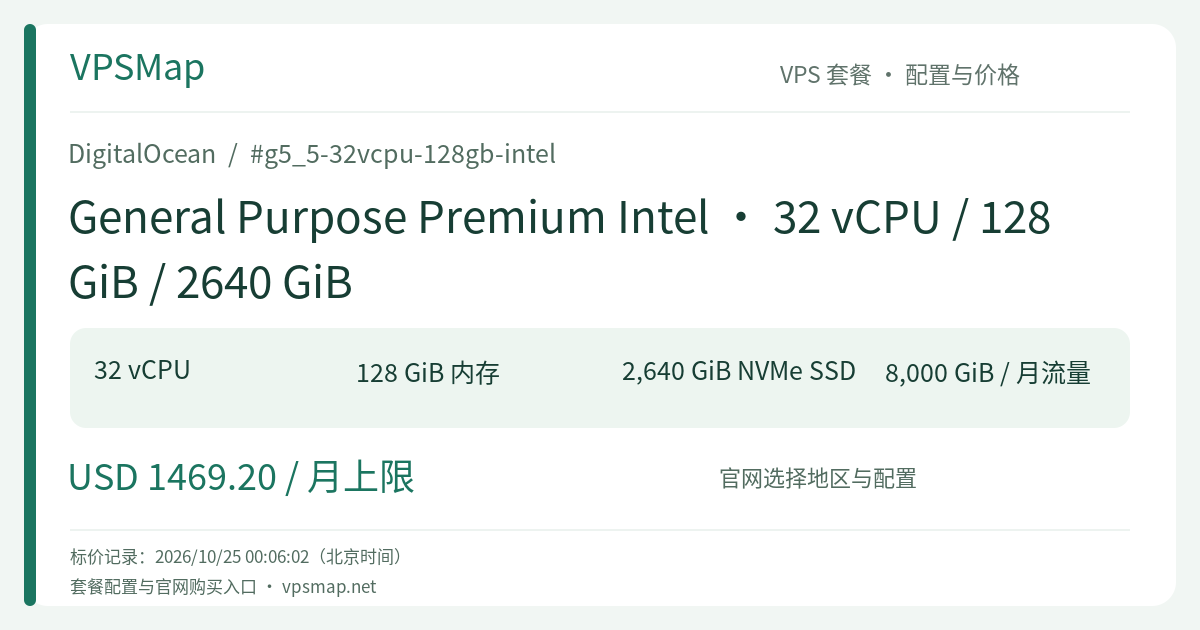
The 2.6 TB Local NVMe Workhorse: In-Depth Review of DigitalOcean's 32 vCPU / 128 GiB / 2640 GiB Droplet
Updated
In modern high-concurrency system design, there is an often-overlooked architectural inflection point: high-frequency random write intensity against massive local working sets.
Most cloud providers push users toward network-attached volumes for large storage footprints. However, when tens of thousands of write transactions must be committed per second, or hundreds of gigabytes of streaming data require unpack-and-rebuild routines in real time, network protocol latency and network fabric congestion become catastrophic bottlenecks.
The DigitalOcean General Purpose Premium Intel 32 vCPU / 128 GiB / 2640 GiB Droplet (slug g5_5-32vcpu-128gb-intel) obliterates this barrier directly. It provisions an enormous 2640 GiB (~2.64 TB) of hypervisor-direct NVMe SSD storage straight across the PCIe bus, seamlessly marrying 32 dedicated CPU cores, 128 GiB of memory, and massive local storage speed into a single unified instance.
What 2640 GiB of Hypervisor-Direct NVMe Actually Unlocks#
This is far more than a simple high-capacity virtual server—it is an I/O powerhouse built for heavy enterprise workloads:
- Zero Cross-Fabric Storage Jitter: The entire 2.64 TB filesystem communicates directly over the hypervisor's local PCIe channels, eliminating the microsecond latency and packet queuing inherent in network storage fabrics. Fsync commits and high-frequency writes resolve with rock-solid consistency.
- Massive Scratch Space & Ultra-Fast Caching:
- Video Rendering & Transcoding Pipelines: High-definition video ingest, intermediate rendering frames, and bulk packaging operations churn through 2.6 TB of local disk at multi-gigabit speeds before final assets are shipped to Spaces Object Storage.
- Monorepo & CI/CD Build Engines: Ideal for massive build clusters compiling complex Android, Chromium, or C++ source trees. The vast NVMe footprint accommodates hundreds of concurrent build workspaces without I/O contention.
- Stream Processing & Distributed Queues: Running Kafka, Redpanda, or ClickHouse directly on local NVMe turns the instance into an ultra-low-latency log storage engine, drastically outpacing network volume architectures.
Robust Compute and Networking Foundations#
Backing this massive disk array is an uncompromising compute architecture:
- 32 Dedicated Intel Xeon Threads: Driven by 3rd Gen Intel Xeon Scalable processors, every vCPU represents a dedicated physical hardware thread. Unhindered by multi-tenant resource contention, performance remains flat and predictable even under 100% sustained utilization.
- 128 GiB Memory Pool: The 4:1 RAM-to-CPU ratio gives the Linux kernel abundant headroom for OS Page Cache buffers, ensuring hot data blocks remain resident in memory and sparing unnecessary drive wear.
- Up to 10 Gbps Network Bursts & 8,000 GiB Pooled Transfer: Premium Intel hardware brings up to 10 Gbps of outbound network throughput. Paired with 8,000 GiB of monthly outbound transfer allowance that pools across your entire DigitalOcean team, handling network-intensive ingest and egress is seamless.
Architectural Simplicity: The Value of Consolidation#
Choosing a high-capacity local NVMe instance yields immediate operational dividends:
- No Block Storage Lifecycle Headaches: Eliminates volume attachment failures, filesystem mount race conditions, and separate storage-pool monitoring.
- Simplified Cluster Topology: In many architectures, anchoring your core system to a single, hyper-performant 32-core / 128 GiB / 2.6 TB node is substantially simpler, more reliable, and easier to debug than managing ten smaller VMs tied together with network storage.
Billing and Operational Safeguards#
- Predictable Cost Ceiling: Billed per second with a monthly cap at 672 hours. Even running continuous 24/7 workloads, monthly expenses stay locked to a transparent maximum. Ad-hoc big data processing jobs can be executed and destroyed on demand.
- High-Availability Design: Because direct-attached NVMe resides on the physical host, high-availability architectures should replicate critical state to a secondary standby node over the internal private VPC, or utilize DigitalOcean's automated incremental backups to safeguard application data.
If your stack is hitting the limits of network storage and demands a unified 32-core compute engine with massive, lightning-fast local NVMe, g5_5-32vcpu-128gb-intel delivers unmatched I/O performance.