DigitalOcean 1 vCPU / 1 GiB Premium AMD Guide: High-Clock Entry-Level Cloud Foundation
Updated
Transcending the Budget VPS Sluggishness: The Premium AMD Edge#
In conventional cloud hosting, a "1 vCPU / 1 GiB" specification often comes with frustrating trade-offs: outdated hypervisors, oversubscribed spinning drives, and sluggish terminal responses where even running apt update or building dependencies feels painfully slow.
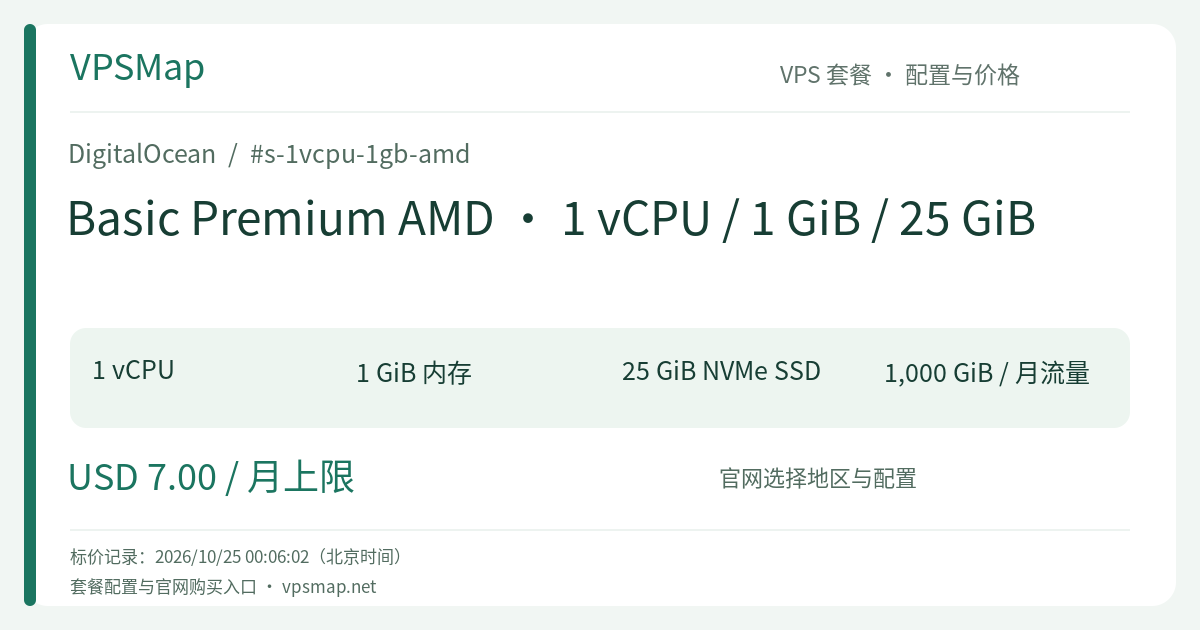
DigitalOcean's Basic Premium AMD 1 vCPU / 1 GiB (slug s-1vcpu-1gb-amd) changes that reality. Built on 2nd or 3rd generation AMD EPYC processors, it pairs modern CPU architecture with 3,200 MHz high-frequency RAM and parallel NVMe solid-state storage. The result is a lightweight cloud instance that delivers snappy single-thread execution and responsive disk operations from the very first boot.
Target Workloads: What Does This Droplet Excel At?#
1. Modern Microservices and Lean Web APIs#
Microservices built with compiled or lean languages—such as Go, Rust, Python FastAPI, or streamlined Node.js—consume minimal idle memory while benefiting immensely from single-thread clock speed and rapid network responsiveness. This configuration is an ideal host for authentication microservices, webhook relays, dynamic URL shorteners, and specialized edge tools.
2. Bots, Automations, and Infrastructure Probes#
Whether deploying an automated Discord/Telegram bot, a lightweight Uptime Kuma uptime monitoring instance, or a remote reverse proxy, the 1 GiB memory profile easily supports continuous background daemons. The 25 GiB NVMe boot disk provides fast read/write speeds for application binaries, logs, and system dependencies.
3. Static Sites and High-Performance Edge Gateways#
Pair this droplet with Nginx or Caddy to serve static content generated via Hugo, Astro, or VitePress. Backed by 1,000 GiB of outbound transfer, it reliably handles high-volume static asset delivery without sweating under moderate traffic.
Practical Resource Boundaries & Memory Hygiene#
To maximize stability on a 1 GiB machine, thoughtful resource planning is essential:
- Navigating the 1 GiB Memory Ceiling: This instance is not intended for monolithic multi-tier architectures running local MySQL, Redis, and a heavy application framework all at once. Best practices dictate configuring a 1–2 GiB swapfile to catch temporary memory spikes and avoid OOM kills. For persistence, lean on embedded SQLite engines or external managed databases like DigitalOcean Managed Databases.
- Shared CPU Burst Dynamics: The shared AMD EPYC thread delivers high single-thread boost performance for intermittent and bursty tasks. For prolonged, sustained 100% compute loads, evaluate dedicated-core alternatives.
Billing Mechanics & Seamless Scalability#
- Micro-Cost Deployment: Priced at approximately $0.01042/hour with a $7 monthly cap, it charges strictly per second. You can launch a sandbox, test an orchestration script, and destroy the Droplet within minutes for pennies. Note that shutting down an active Droplet preserves its compute allocation and continues billing; destroying it ends billing completely.
- Pooled Outbound Bandwidth: The 1,000 GiB transfer quota rolls into your team's cumulative bandwidth pool. Inbound traffic is always free, and intra-VPC communication remains private and unmetered.
- Frictionless Resizing: When your traffic expands, the DigitalOcean control panel allows straightforward vertical resizing to 2 GiB or 4 GiB tiers with minimal friction.
Conclusion & Action#
If you want an affordable entry-level Linux machine that does not compromise on I/O responsiveness and CPU agility, the s-1vcpu-1gb-amd Droplet is a prime starting point.
Check live datacenter availability and launch your instance directly via the DigitalOcean Console.