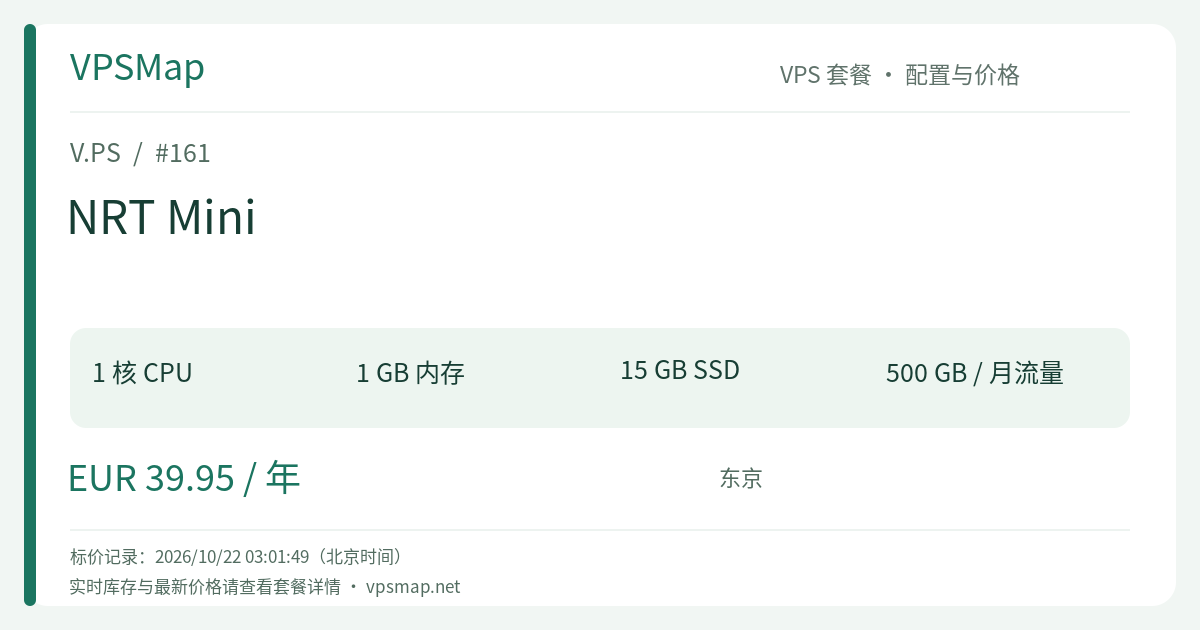
V.PS Tokyo NRT Mini Yearly VPS Review: A €39.95/Yr Lightweight Outpost in Japan
Updated
Why an Annual Lightweight Node in Tokyo Is a Strategic Asset#
In cloud infrastructure planning, Tokyo (NRT) serves as the primary gateway for Asia-Pacific traffic. Connecting East Asia, Southeast Asia, and transpacific routes to North America, Tokyo datacenters offer strategic routing advantages. However, major cloud platforms (such as AWS, GCP, or Azure) impose high egress fees and recurring monthly charges for idle instances and static public IPv4 allocations in the Tokyo region.
The V.PS NRT Mini annual plan lowers this barrier at €39.95/year (approximately €3.33/month):
- Predictable Annual Budgeting: A single annual payment guarantees year-round availability without monthly invoice friction, complete with dedicated IPv4 and IPv6 dual-stack addressing.
- 400 Mbps Port Speed: Backed by a 400 Mbps uplink and a 500 GB monthly transfer quota, it avoids the restrictive bandwidth caps (often 10–30 Mbps) typical of low-cost edge plans.
- Standard KVM Virtualization: Full root-level kernel access supporting modern Linux distributions (Debian, Ubuntu, AlmaLinux, Rocky Linux) and custom installs via netboot.xyz.
Comparing NRT Mini vs. NRT Mini Pro#
Within the V.PS Tokyo lineup, the Mini family caters specifically to cost-effective annual deployments. Understanding the exact hardware boundaries helps clarify the right fit:
| Specification | NRT Mini (Current Plan) | NRT Mini Pro |
|---|---|---|
| CPU Allocation | 1 Core | 1 Core |
| System Memory | 1 GB | 1 GB |
| Storage Type & Size | 15 GB SSD | 15 GB NVMe |
| Monthly Bandwidth | 500 GB | 600 GB |
| Network Uplink | 400 Mbps | 500 Mbps |
| Annual Price (EUR) | €39.95 /year (~€3.33/mo) | €49.95 /year (~€4.16/mo) |
Evaluation Insight: With a price delta of just €10/year, the NRT Mini focuses on baseline operational utility. For workloads characterized by network proxying, synthetic monitoring, and lightweight background automation where disk I/O is rarely saturated, the standard SSD-backed NRT Mini provides maximum cost efficiency.
4 Practical Scenarios for NRT Mini#
1. Secure Asia-Pacific Jump Server (SSH Bastion)#
Exposing production clusters directly to the open Internet introduces unnecessary risk. Positioning NRT Mini as a dedicated jump server in Tokyo establishes a hardened entry point:
- Enforce SSH public-key authentication paired with two-factor authentication (2FA) or a WireGuard tunnel.
- Engineers can route administrative sessions through this stable Tokyo node to reach backend resources, minimizing exposed attack surfaces across cloud environments.
2. Uptime Monitoring & Distributed Health Probes (Uptime Kuma / Node Exporter)#
Evaluating website and API reliability requires external geographic vantage points. NRT Mini serves as an ideal regional health probe:
- Deploy lightweight monitoring tools like Uptime Kuma or Prometheus Node Exporter to poll target services via HTTP, TCP, and ICMP protocols.
- Under a minimal Debian base, monitoring daemons and alerting bots consume less than 5% of CPU capacity, leaving the 1 GB of memory largely vacant.
3. Automation Bots & Microservices (Telegram / Discord / Webhooks)#
Event-driven automation routines—such as deployment notifications, scheduled sync scripts, and financial alert bots—require reliable uptime rather than intense compute. NRT Mini provides continuous availability for Python, Node.js, and Golang binaries within its 500 GB monthly allowance.
4. Private DNS Caching & Regional Resolver#
Equipped with native dual-stack IPv4 and IPv6 connectivity, NRT Mini can run a local caching DNS service (such as CoreDNS or Unbound), reducing resolution latency and providing consistent lookups across regional test environments.
Resource Constraints & Recommended Tuning#
Operating efficiently within a 1 Core / 1 GB RAM configuration requires practical OS-level hygiene:
- Configure Swap or zram:
- When running package management updates (
apt upgrade) or building light packages, memory spikes can occur. Provisioning a 1 GB to 2 GB swapfile or enablingzramprevents unexpected termination of critical daemons by the Linux kernel OOM killer.
- When running package management updates (
- Manage 15 GB SSD Storage:
- A standard server installation leaves approximately 10 to 12 GB of free space. Set up automated log rotation via
logrotateand clean up unused Docker images to ensure storage remains unconstrained.
- A standard server installation leaves approximately 10 to 12 GB of free space. Set up automated log rotation via
- Shared vCPU Etiquette:
- The single CPU core operates as a virtualized shared resource. It accommodates bursts and normal processing cycles effortlessly, but continuous full-load utilization (such as perpetual compute mining) violates standard acceptable use guidelines.
Step-by-Step Purchasing Walkthrough#
Follow these verified steps to locate and activate your instance:
- Access the Official Portal: Visit the V.PS Official Order Portal. The tracking attribution registers automatically before landing on the main portal.
- Locate Mini KVM VPS: Click Deploy a Server or navigate to Products -> KVM VPS, then select the Mini KVM VPS product category.
- Select Tokyo NRT Mini: Under the Tokyo NRT section, find NRT Mini (1 CPU core, 1 GB memory, 15 GB SSD, 500 GB transfer, 400 Mbps port, €39.95 /yr) and click Order.
- Choose OS and Network Options:
- Select a lightweight distribution such as Debian 12 or Ubuntu 22.04 LTS, or opt for netboot.xyz for custom installation media.
- You can test connectivity and route latency beforehand using the official Looking Glass tool for Tokyo.
- Review Billing Details & Complete Checkout:
- Enter accurate billing details, including your legal name and residential address, to pass the automated anti-fraud review.
- Supported payment channels include PayPal, major credit cards, and regional methods such as Alipay.
- Instant Provisioning: Once payment processes, the virtual machine is generated in seconds. The V.PS client area provides power controls, OS rebuild options, emergency VNC access, and rDNS management.
Refund Terms & Policy Guidelines#
V.PS provides a 14-calendar-day refund window via support ticket for VPS orders, strictly governed by the following criteria:
- Limited to one refund per customer account across all purchases.
- Outbound and inbound data consumption must remain below 10 GB.
- No active BGP sessions or IX peering services attached to the VM.
- The service has not been transferred between customer accounts.
- The assigned IP address must not have received abuse reports or been placed on blacklists (including Spamhaus, blocklist.de, or regional blocking systems).
- No IP replacement has been requested.
- Payments completed via cryptocurrency or bank wire are non-refundable; invoice renewals and promotional flash-sale orders are strictly exempt from refunds.