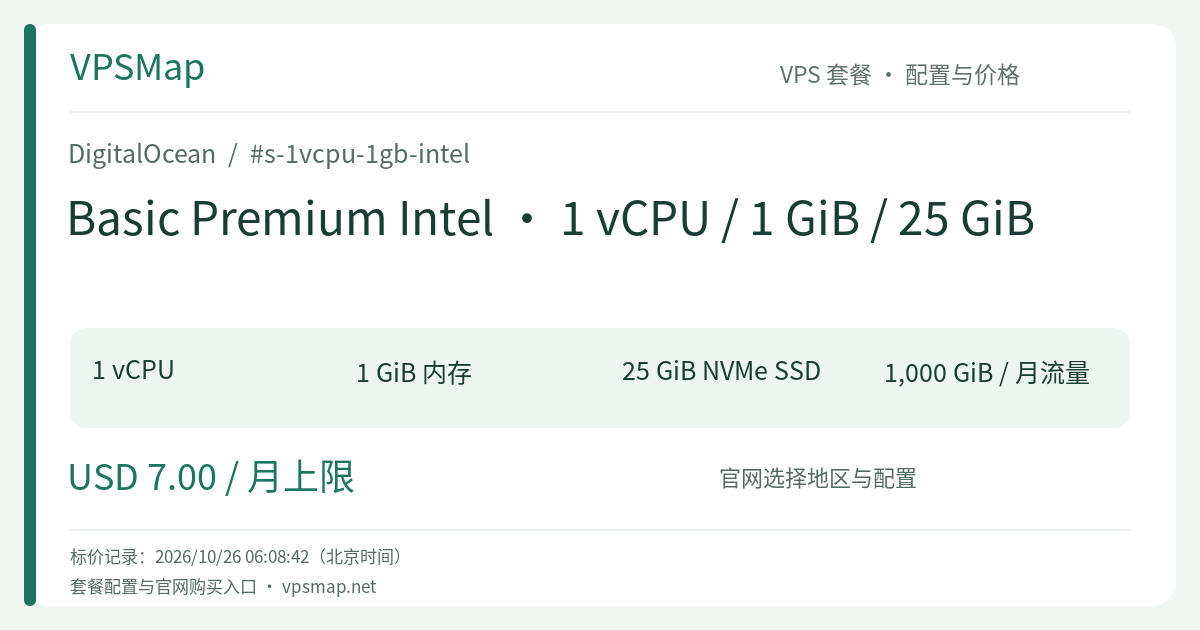
DigitalOcean 1 vCPU / 1 GiB Premium Intel Droplet: The Lean Foundation for Micro-Services and Side Projects
Updated
Why Entry-Level VMs Need High Clock Speeds and NVMe#
When evaluating low-cost, entry-level cloud servers, developers often prioritize the bottom-line price while overlooking underlying hardware quality. On a 1 vCPU / 1 GiB system, every single resource bottleneck is magnified: if the host CPU is an aging, low-frequency processor or the disk relies on legacy SATA storage, basic operational commands like apt update && apt upgrade or npm install can lock up CPU cycles and cause terminal sessions to freeze.
The DigitalOcean Basic Premium Intel · 1 vCPU / 1 GiB / 25 GiB Droplet (s-1vcpu-1gb-intel) redefines what an entry-tier virtual machine can deliver. Powered by 2nd or 3rd Generation Intel Xeon Scalable processors, 2933 MHz RAM, and direct NVMe solid-state storage, it delivers crisp, responsive performance for essential cloud tasks.
Core Technical Strengths: Intel Single-Thread Power & NVMe Throughput#
- High Single-Core Clock Speeds: Intel Xeon Scalable processors offer dependable single-threaded execution. For single-threaded workloads—such as Node.js utilities, Python scripts, or static file delivery—the high IPC ensures tasks execute quickly and return system resources to idle.
- NVMe Storage Eliminates I/O Wait: The 25 GiB NVMe boot disk provides high parallel IOPS compared to standard SSDs. System boots, package updates, and SQLite commits complete near-instantly, eliminating the notorious
iowaitfreezes common in budget hosting. - 1,000 GiB Outbound Bandwidth Pool: The included 1,000 GiB of outbound transfer is pooled across all Droplets under your team account, while inbound traffic is completely free—more than enough for personal utilities or lightweight production services.
Ideal Workload Scenarios#
This lean Droplet is exceptionally well-suited for:
1. Modern Personal Blogs & Static Edge Proxies#
Deploying static sites built with Astro, Hugo, or Zola served via Caddy or Nginx with automated TLS certificates. Alternatively, host lightweight CMS platforms like Ghost (paired with SQLite) for snappy reader experiences on a minimal budget.
2. Autonomous Bots & Webhook Consumers#
Keep Telegram bots, Discord bots, GitHub webhook endpoints, or lightweight workflow automations (such as a lean n8n instance) running continuously. These utilities idle most of the time but need fast single-core response when an event triggers.
3. Dedicated VPN Gateways & Private DNS Resolvers#
Use this Droplet as a dedicated WireGuard or Tailscale exit node, or run an AdGuard Home / Pi-hole instance for encrypted, ad-blocking DNS queries. The 2 Gbps network interface and 1,000 GiB bandwidth ensure low-latency throughput.
4. Remote Development Sandboxes & Uptime Probes#
Maintain a cloud-based development environment with Neovim, tmux, and your favorite CLI tools, or deploy an Uptime Kuma instance to monitor global availability across your commercial platforms.
Practical Tuning Guidelines for 1 GiB Systems#
Operating within a 1 GiB memory footprint requires sensible system configuration:
- Configure a 1–2 GiB Swapfile: Linux systems benefit greatly from swap space during unexpected memory spikes. Create a 1 GiB swapfile on the NVMe drive to protect critical processes from the kernel's OOM killer.
- Lean Service Selection: Choose lightweight distributions like Debian or Alpine, favor Caddy over bulky web stacks, and select SQLite over heavyweight database engines whenever feasible.
- Set Up Cloud Alerts: Take advantage of DigitalOcean's free monitoring agent to receive email or Slack alerts when memory utilization exceeds 85%, giving you ample warning to optimize or scale.
Billing Clarity & Effortless Scaling#
- Precise Per-Second Billing: Billed per second with a monthly cap of 672 hours, spinning this instance up for short-term experimentation costs mere pennies.
- Frictionless Resizing: If your project gains traction and outgrows 1 GiB of RAM, DigitalOcean's seamless resize feature allows you to upgrade CPU and RAM in just a few clicks without changing IP addresses or reconfiguring your OS.
Notice: Real-time availability is confirmed within the cloud console during deployment. Choose the region closest to your primary audience for minimal network latency.