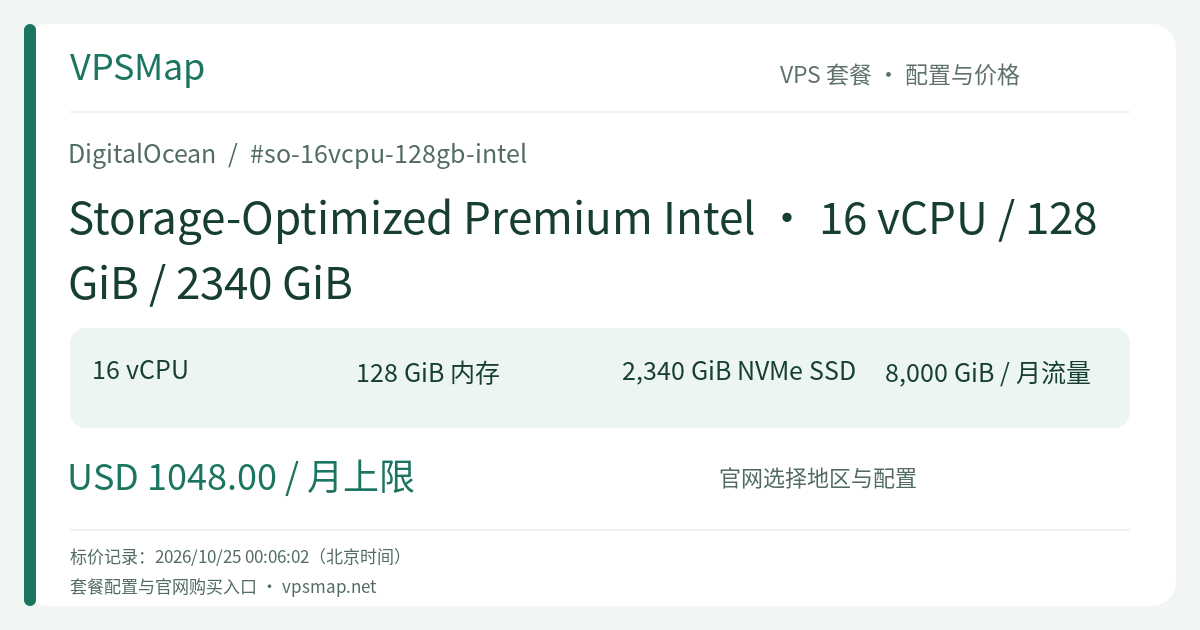
DigitalOcean 16 vCPU / 128 GiB Storage-Optimized Premium Intel Guide: The Sweet Spot for High-IOPS Databases and Direct-Attached NVMe
Updated
The Case for Direct-Attached NVMe in Production#
When cloud-hosted applications experience database slowdowns, the instinctive reaction is often to upgrade vCPU count. In practice, however, the real performance wall in data-intensive systems—relational databases (PostgreSQL, MySQL), distributed search clusters (Elasticsearch, OpenSearch), and continuous time-series engines (Prometheus, VictoriaMetrics)—is almost always storage I/O latency and disk queuing.
While network-attached block volumes offer operational convenience like easy volume resizing, their traffic must traverse the hypervisor virtual network, physical switches, and remote storage appliances. Under heavy transaction bursts or continuous bulk ingestion, microsecond network jitters snowball into transaction lock waits, query timeouts, and exhausted connection pools.
The so-16vcpu-128gb-intel (Storage-Optimized Premium Intel) droplet exists to eliminate this uncertainty. By provisioning 2340 GiB of NVMe solid-state storage directly attached to the hypervisor's physical PCIe bus, I/O calls bypass network layers entirely, unlocking low-latency performance and high parallel queue depth directly on bare metal.
Architectural Breakdown and Hardware Profile#
Every metric in this droplet tier has been engineered to maintain harmonic balance under intense production workloads:
1. 16 Dedicated vCPUs (Premium Intel)#
Powered by 3rd Generation Intel Xeon Scalable processors, every vCPU maps directly to a dedicated hardware hyper-thread. There is no CPU cycle sharing and no noisy neighbor interference. Whether your system is handling Lucene segment merges, concurrent analytical queries, or heavy background vacuuming, response latency remains fully deterministic.
2. 128 GiB RAM (Optimized 8:1 Ratio)#
Carrying the ideal 8 GiB RAM per vCPU ratio, 128 GiB delivers sufficient working space for modern engines:
- PostgreSQL / MySQL: Allocate 80–90 GiB to
shared_buffersor the InnoDB Buffer Pool, ensuring the majority of active index trees and hot rows stay pinned in RAM. - Elasticsearch / OpenSearch: Cap the JVM heap safely at 31 GiB (preserving Compressed OOPs pointers) while reserving the remaining ~90 GiB for Linux kernel page cache to supercharge Lucene index memory mapping.
3. 2340 GiB Hypervisor-Attached NVMe#
The cornerstone of this configuration. Built with high concurrency queues, direct NVMe storage reduces database WAL (Write-Ahead Logging) write latency to the sub-millisecond range. High-frequency fsync operations complete immediately, preventing downstream transaction queues from bottlenecking.
4. 10 Gbps Network Pipe & 8000 GiB Transfer Pool#
Premium Intel Droplets are granted up to 10 Gbps of outbound network bandwidth—up to 5x faster than standard CPU variants. Combined with an 8000 GiB monthly public egress quota (inbound traffic is completely free) pooled at the team level, cross-node replication and snapshot creation operate without saturating network interfaces.
Targeted Production Workloads#
| Workload | Common Production Pain Point | How This Instance Resolves It |
|---|---|---|
| High-Volume MySQL / PostgreSQL Primary | Network volume IOPS caps delay transaction commits during flash sales | Direct NVMe handles sustained high-frequency writes; 128G RAM caches active tables |
| Elasticsearch / OpenSearch Hot Data Nodes | Heavy indexing combined with concurrent user queries exhausts disk queues | 31G heap + 90G OS filesystem cache; 2.3TB NVMe processes bulk document indexing |
| Time-Series Ingestion (Prometheus / TimescaleDB) | Millions of concurrent metric samples create ongoing append-only pressure | Dedicated cores accelerate aggregations; direct storage ingests continuous data streams |
| High-Throughput Kafka Brokers | Message persistence demands fast sequential writes and fast consumer catch-up | Hypervisor NVMe sequential throughput paired with 10 Gbps networking handles peaks |
Economics and Value Analysis ($1,048/mo)#
At a list price of $1,048.00/month ($1.55952/hour), this instance targets mission-critical deployments where downtime and latency spikes translate to real business losses. DigitalOcean bills Droplets per second with a predictable 672-hour (28-day) monthly cap. You only pay for active seconds up to 672 hours; any remaining runtime in a calendar month is free.
Key cost advantages include:
- No Hidden IOPS Surcharges: Unlike legacy hyperscalers that charge separately for provisioned IOPS, burst credits, and throughput tiers, all performance here is delivered natively by the physical drive at no extra cost.
- Reduced Cluster Complexity: Consolidating workloads onto a robust 16-core / 128 GiB / 2.3TB NVMe node avoids the cognitive, operational, and network overhead of managing numerous smaller, fragmented nodes.
Operational Considerations & Best Practices#
[!IMPORTANT] High Availability with Direct-Attached Storage: Direct-attached NVMe delivers raw speed by tying storage to the physical hypervisor. In the unlikely event of physical hardware degradation, data on local disks does not automatically detach and re-attach to another server like network volumes do. Always deploy mission-critical databases with application-level replication (e.g., PostgreSQL streaming replication, primary-replica pairs) and maintain automated backup schedules.
- Billing While Powered Off: Because dedicated compute cores, RAM, and physical drive space remain exclusively reserved on the hypervisor, billing continues even if the droplet is powered down. To stop billing, the Droplet must be destroyed after taking a snapshot.
- Private VPC Network: Intra-cluster traffic within the same region over private VPC is free and does not deduct from your 8000 GiB transfer allowance.
Deploy your high-throughput database or search cluster with dedicated compute and direct storage: 👉 Configure this Droplet on DigitalOcean