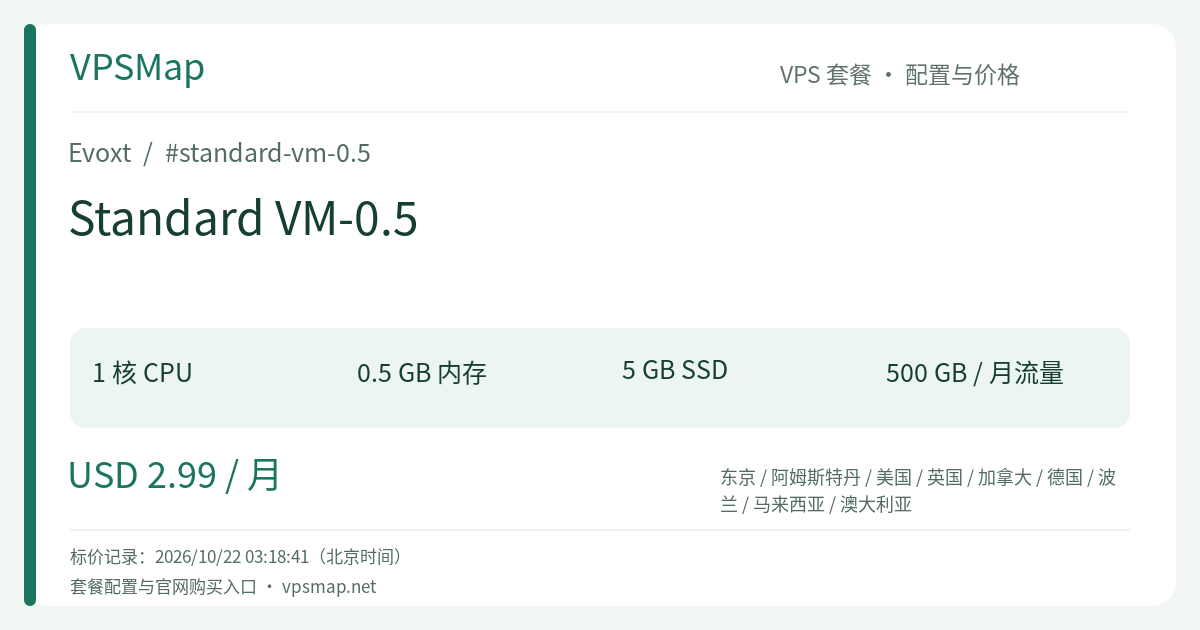
Evoxt Standard VM-0.5 Review: What Can You Really Do with a $2.99/mo High-Frequency Micro VPS?
Updated
Why an Ultra-Budget 512MB VPS Deserves Your Attention#
In a cloud market dominated by oversized instances and high entry costs, micro virtual machines priced at $2.99/month are often dismissed as simple novelties. However, Evoxt's Standard VM-0.5 pairs extreme affordability with an unexpected feature set: up to 6.0 GHz Turbo single-core frequency, a full 1 Gbps port, 500 GB monthly bandwidth, and complimentary automated weekly offsite backups with Layer 3 firewall protection.
This is not a sluggish legacy slice pinned to throttled 2.0 GHz CPUs. It is an agile, low-latency micro-node engineered for high execution responsiveness and rapid network throughput. For engineers, webmasters, and developers seeking reliable isolated runtime environments without recurring cost burdens, VM-0.5 solves critical infrastructure tasks for the price of a monthly cup of coffee.
Hardware Specifications & Operational Boundaries#
Making an informed infrastructure choice requires a realistic view of hardware limits and real-world allowances:
| Dimension | Specification | Engineering Insight |
|---|---|---|
| CPU | 1 vCore (Up to 6.0 GHz Turbo) | Superior single-thread responsiveness; dynamic operations finish quickly. Not intended for sustained 100% compute loads. |
| RAM | 512 MB | Too compact for heavy stacks like MySQL 8 or monolithic panels; ideal for compiled binaries and lean scripts. |
| Storage | 5 GB SSD | Clean Linux installations leave roughly 3.5GB–4GB free space; proactive log management is essential. |
| Network | 1 Gbps Port / 500 GB Transfer | Full gigabit burst speed across 9 Standard global regions with ample monthly transfer allowance. |
| Backup & Security | Free Weekly Offsite Backup + L3 Firewall | Rapid one-click disaster recovery directly inside the Evoxt VM console. |
| Base Pricing | $2.99 / month (Monthly up to 3 years) | Flexible payment gateways including Credit/Debit cards, PayPal, Bitcoin, and USDT Tron. |
Realistic Takeaway: With 512MB memory and 5GB disk, this instance cannot host bloatware, standard control panels, or unoptimized application stacks. It is built as a dedicated single-purpose workhorse where lightweight architectures shine.
High-Value Deployment Scenarios#
1. Private Network Gateways & Reverse Tunnels#
If you require a clean remote egress point, a personal WireGuard connection, or an ingress reverse proxy via frp, Cloudflare Tunnel, or Gost, VM-0.5 delivers exceptional value. Its 1 Gbps uplink and high-clock CPU ensure minimal handshake latency and uninhibited throughput.
2. Isolated Uptime Monitoring & Probes (Uptime Kuma)#
A common operational mistake is running status checkers on the exact same infrastructure hosting production workloads. By deploying Uptime Kuma with an embedded SQLite database on a separate VM-0.5, you create an out-of-band monitoring sentinel that verifies service health, SSL expiration, and API latencies 24/7 at negligible cost.
3. Lightweight Automation, Bots & Webhook Listeners#
Telegram bots, Discord automation, and CI/CD webhook listeners coded in Go, Rust, or minimal Node.js typically consume between 30MB and 100MB of RAM. Running these persistent daemons on VM-0.5 keeps your primary workstations clean and provides 99.99% operational uptime.
4. Lean Static Sites & Micro-APIs (Caddy + Static/SQLite)#
Paired with memory-efficient web servers like Caddy, VM-0.5 easily hosts personal landing pages, documentation wikis, or fast micro-APIs. The up to 6.0 GHz clock rate accelerates cryptographic TLS handshakes and asset dispatch.
Memory & Storage Optimization Blueprint#
To ensure flawless operation on a 512MB RAM / 5GB disk footprint, implement these foundational optimizations upon deployment:
- Opt for Minimal Distributions: Deploy Debian 12 Minimal or Alpine Linux without desktop packages or auxiliary daemons.
- Establish a Swap File: Create a 1GB swap partition to absorb sudden memory spikes and prevent immediate out-of-memory kernel panics:
fallocate -l 1G /swapfile chmod 600 /swapfile mkswap /swapfile swapon /swapfile echo '/swapfile none swap sw 0 0' >> /etc/fstab - Cap Systemd Journal Sizes: In
/etc/systemd/journald.conf, defineSystemMaxUse=50Mso system logs cannot quietly consume your available disk quota.
Tier Comparison: Is VM-0.5 the Right Fit?#
- Compared to Standard VM-0.75 ($4.99/mo): VM-0.75 grants 1GB RAM and 10GB disk space. If your project mandates standard Docker daemon setups or dynamic application runtimes, the extra $2/month is well invested. But for single-binary microservices or simple tunnels, VM-0.5 saves $24 annually.
- Compared to Standard VM-1 ($5.99/mo): VM-1 doubles storage to 20GB and RAM to 2GB, serving as the benchmark for WordPress sites. If you don't need a full CMS environment, staying on VM-0.5 remains the cleaner, more cost-effective choice.
Global Availability & Order Walkthrough#
Evoxt Standard instances are deployed across major worldwide hubs—including Los Angeles, New York, London, Frankfurt, Amsterdam, Warsaw, Montreal, Tokyo, Malaysia, and Sydney. Availability and inventory vary dynamically by data center.
Step-by-Step Order Guide:#
- Open the deployment portal: Deploy Standard VM-0.5 on the Official Evoxt Console.
- Create your account or log in, then locate VM-0.5 under the Standard catalog tier.
- Select your target region based on user proximity and latency priorities.
- Pick your OS template (Debian 12 is recommended) and designate a billing term (monthly, annually, or multi-year).
- Complete checkout. Your instance will spin up within 2.5 minutes, providing instant access to root credentials, web-based VNC, Layer 3 firewall configurations, and automated weekly backup schedules.