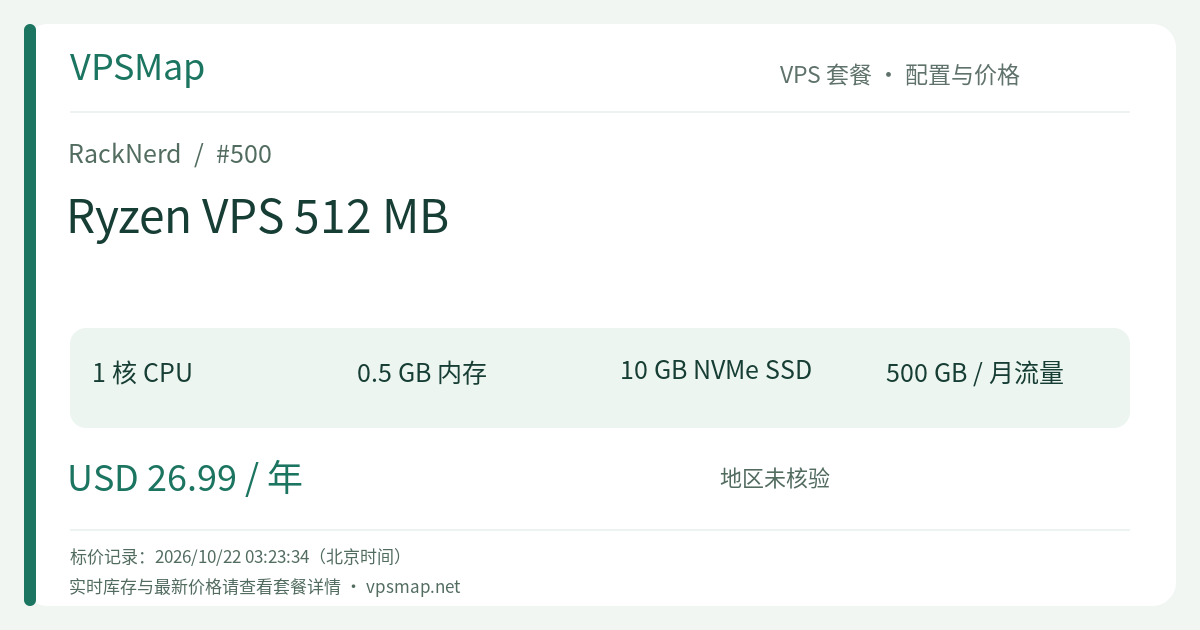
RackNerd Ryzen 512 MB VPS Buyer's Guide: High-Clock Light Node at $26.99/Year — Where It Delivers Maximum Value
Updated
If you are looking for an ultra-low annual commitment server that sacrifices neither single-core computing power nor disk I/O performance, the RackNerd Ryzen VPS 512 MB (PID 500) represents a remarkably focused infrastructure choice.
Budget annual servers around twenty-something dollars typically imply legacy Intel Xeon allocations coupled with mechanical arrays or standard SATA SSDs. This instance, however, is built on AMD Ryzen 3900X processors and pure NVMe SSD storage. While its memory is restricted to 512 MB and disk to 10 GB, its execution efficiency and responsiveness in high-IPC, I/O-intensive lightweight micro-tasks noticeably outperform conventional budget architectures.
Core Specifications & Hardware Foundation#
- CPU Architecture: 1 vCore (AMD Ryzen 3900X high clock speed, strong single-threaded IPC)
- System Memory: 512 MB RAM
- Storage: 10 GB Pure NVMe SSD (official disk I/O benchmark speeds surpass 1 GB/s)
- Monthly Bandwidth: 500 GB @ 1Gbps port (accelerated via Noction IRP route optimization)
- Networking: 1 Dedicated IPv4 included (up to 100 free IPv6 addresses available upon ticket request in Los Angeles DC-02)
- Virtualization: Full KVM virtualization, complete root access, HTML5 VNC console, and custom ISO support
- Base Price: $26.99 / year (averaging approximately $2.25 / month)
- Direct Link: Order RackNerd Ryzen VPS 512 MB
Practical Production Use Cases#
512 MB of RAM requires strict resource awareness, but within modern development workflows, it excels as an isolated micro-node:
Compiled Microservices in Go, Rust, or C
Standalone binary applications often idle at tens of megabytes of RAM. The Ryzen 3900X architecture processes API calls and compute loops with minimal latency, while NVMe storage eliminates disk serialization bottlenecks.Private DNS Resolvers, Lightweight Relays, and WireGuard Gateways
Ideal for hosting focused networking utilities such as CoreDNS, minimal AdGuard Home personal instances, or WireGuard point-to-point tunnels. The 500 GB monthly transfer is generous for secure encrypted traffic and routing relays.Uptime Probes and Automated Cron Daemons
Execute scheduled maintenance tasks, API status monitors, health-check probes, and Let's Encrypt certificate automation. Fast CPU burst capability ensures short-lived scripts finish and exit immediately.Telegram / Discord Webhook Notification Bots
Run continuous, low-overhead event listeners that consume alerts from GitHub, GitLab, or server monitoring stacks, formatting and dispatching messages 24/7 without degrading.
Essential Trade-offs & Limitations#
Buying a 512 MB machine requires clear technical boundaries:
- Not for bloated control panels: Avoid installing heavy multi-tier hosting panels (e.g., cPanel, Plesk, or memory-heavy all-in-one stacks). Memory exhaustion (OOM) will trigger during package compilation or database startup.
- Not for self-hosted AI stacks: RackNerd's ctrl control panel supports catalog deployments like AnythingLLM, Ollama, and Hermes Agent, but those require 4 GB to 8 GB RAM minimum. This plan cannot handle local AI workloads.
- Disciplined disk usage: The 10 GB NVMe allocation is designed for operating system and application execution. With the OS consuming 2-3 GB, keep application logs and cache artifacts tightly managed.
Comparison with Adjacent Options#
| Specification | Ryzen VPS 512 MB (This Plan) | KVM Special 1 GB (Annual Special) | Ryzen VPS 1 GB (Monthly Tier) |
|---|---|---|---|
| Billing Cycle | $26.99 / year | $21.99 / year | $17.99 / month |
| CPU Platform | AMD Ryzen 3900X (1 vCore) | Intel Xeon (1 vCore) | AMD Ryzen 3900X (1 vCore) |
| Memory | 512 MB | 1 GB (1024 MB) | 1 GB (1024 MB) |
| Storage | 10 GB NVMe SSD | 20 GB RAID-10 SSD | 15 GB NVMe SSD |
| Bandwidth | 500 GB @ 1Gbps | 3000 GB (3 TB) @ 1Gbps | 1000 GB (1 TB) @ 1Gbps |
| Best Suited For | High IPC & NVMe speed for tiny microservices | General container/web workloads needing RAM headroom | Short-term staging without 12-month lock-in |
Decision Matrix:
- Choose the Ryzen 512 MB ($26.99/yr) if your workload is memory-lean (Go/Rust/C) and you want top-tier CPU and disk responsiveness at rock-bottom annual costs.
- Choose the KVM Special 1 GB ($21.99/yr) if your application stack needs at least 1 GB of RAM and larger storage for general Docker deployment.
- Choose the Ryzen 1 GB ($17.99/mo) only if you require Ryzen single-core performance on a strictly short-term, month-to-month billing schedule.
Ordering & Initial Setup Instructions#
- Location Selection: Select a primary routing hub such as Los Angeles DC-02 or San Jose. If you need IPv6, choose Los Angeles DC-02 and submit a quick support ticket post-activation to receive up to 100 free IPv6 addresses.
- Operating System: Select Debian 12 64-bit Minimal or Ubuntu 22.04 Minimal. These lightweight images typically idle under 90 MB RAM after boot, leaving over 400 MB for your workloads.
- Add Swap Space: Create a 1 GB swap file immediately to buffer memory during updates:
fallocate -l 1G /swapfile chmod 600 /swapfile mkswap /swapfile swapon /swapfile echo '/swapfile none swap sw 0 0' >> /etc/fstab - Limit Systemd Journals: Preserve your 10 GB NVMe space by restricting journal storage in
/etc/systemd/journald.confwithSystemMaxUse=200M.