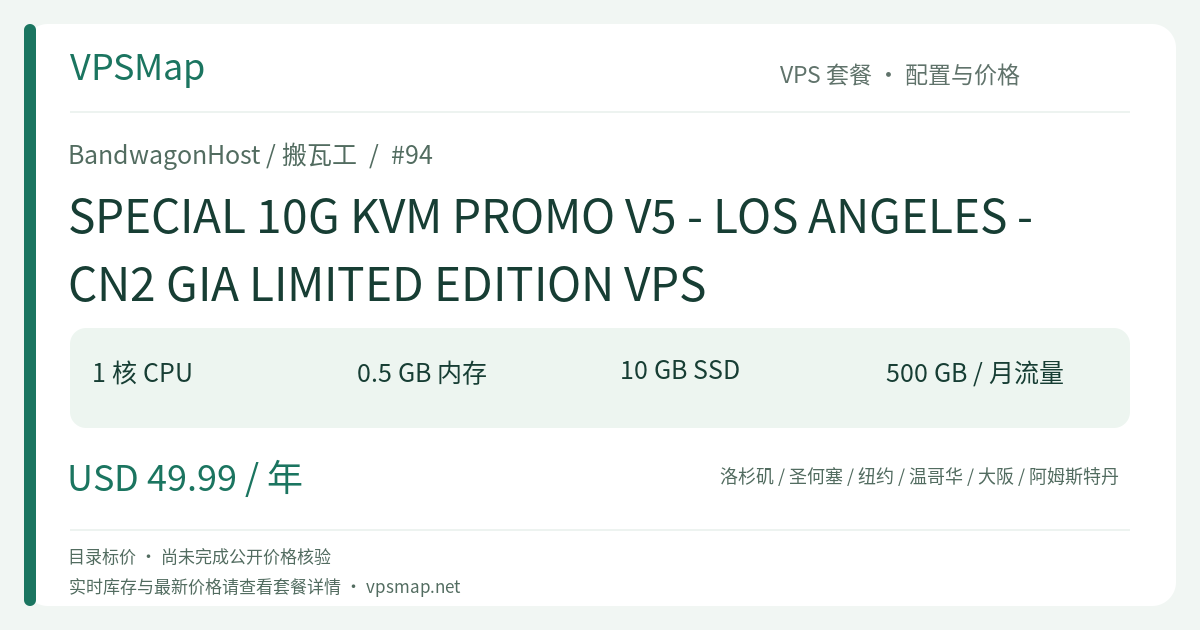
BandwagonHost $49.99 CN2 GIA Limited Edition (PID 94) Deep Dive: The Legendary Gateway to DC6, DC9, and Free Multi-DC Migration
Updated
Why PID 94 Is Acclaimed as the Undisputed Classic of BandwagonHost#
In the realm of premium cross-border cloud hosting, BandwagonHost’s Los Angeles CN2 GIA network is universally recognized as the gold standard. In its Los Angeles facilities, BandwagonHost operates eight 10 Gbps CN2 GIA and CTGNet enterprise uplinks, augmented by direct private peering with Google and major regional carriers. Even during intense peak evening hours—when standard transatlantic and transpacific IP transit regularly suffers from packet loss exceeding 30%—BandwagonHost's CN2 GIA routes remain remarkably rock-solid with low jitter and zero throttling.
However, top-tier international connectivity comes with high infrastructure costs. BandwagonHost's flagship regular CN2 GIA-E plan (PID 87) retails for $169.99 annually. For budget-conscious developers, personal bloggers, or teams simply requiring a reliable low-latency bastion server, that annual outlay can be daunting.
The SPECIAL 10G KVM PROMO V5 (PID 94) was introduced to shatter that barrier: offering the exact same enterprise Los Angeles CN2 GIA network pipeline for just $49.99 per year (around $4.10 per month). Crucially, it did not compromise network quality, retaining full access to premier Los Angeles DC6 and DC9 routing alongside seamless KiwiVM datacenter migrations. This winning combination of entry-level pricing and top-tier transit cemented PID 94 as one of the most legendary hosting plans in the community.
Core Specifications and the Multi-Datacenter Roaming Advantage#
Let us review the exact hardware parameters and technical capabilities:
| Specification Parameter | Official Baseline | Architectural & Practical Impact |
|---|---|---|
| vCPU Cores | 1 vCPU (KVM Virtualization) | Sufficient for edge proxies, background schedulers, DNS, and static web |
| RAM Allocation | 512 MB | Ultra-compact memory footprint; best paired with Swap tuning (guide below) |
| SSD Storage | 10 GB Enterprise SSD | Fully redundant storage architecture safeguarding base OS and application files |
| Monthly Traffic | 500 GB | Generous high-speed bidirectional transfer for daily operational communication |
| Port Speed | 1000 Mbps (1 Gbps) | Gigabit enterprise uplink delivering unthrottled burst bandwidth |
| Annual Price | $49.99 USD / Year | Unmatched sub-$50 annual entry point into premier CN2 GIA networking |
| Datacenter Roaming | Free, lossless multi-DC migration | LA DC6/DC9, Osaka Softbank, San Jose, New York, Vancouver, Amsterdam |
The Killer Feature: Free KiwiVM Multi-Datacenter Migration#
The true superpower of PID 94 lies not merely in its Los Angeles baseline, but in KiwiVM’s built-in free datacenter migration capability:
- Los Angeles DC6 (USCA_6): Powered by massive CN2 GIA-E bandwidth, engineered for high-throughput commercial applications;
- Los Angeles DC9 (USCA_9): BandwagonHost’s primary flagship node, featuring tri-carrier China optimization via China Telecom CN2 GIA (AS4809), China Unicom Premium (AS10099), and China Mobile CMIN2 (AS58807), coupled with exceptional local peering;
- Japan Osaka Softbank (JPOS_1): Direct Softbank transit for ultra-responsive East Asian routing;
- North American & European Nodes: San Jose, New York, Vancouver, and Amsterdam.
Within the KiwiVM management dashboard, migrating to a different node requires just a few clicks. The platform automatically images the disk, migrates the container, and provisions a clean IP address in the destination cluster—completely preserving your data. A single $49.99 subscription effectively doubles as a multi-region global deployment pass.
512MB RAM Tuning Guide: Squeezing Maximum Stability from Lean Specs#
A single core, 512MB RAM, and 10GB disk represent the physical boundaries of this machine. If loaded with resource-heavy web panels or unoptimized database instances, memory exhaustion will inevitably trigger OOM errors. However, with sensible system-level tuning, a 512MB Linux instance can run reliably for years without a single reboot. Follow these proven configuration steps:
Step 1: Deploy a Minimal Operating System#
When provisioning the operating system in KiwiVM, select Debian 12 64-bit Minimal. On clean boot, Debian 12 uses merely 60MB to 80MB of active RAM, leaving more than 400MB of pure physical memory dedicated to your applications.
Step 2: Establish an Optimized Swap Partition#
Allocating a 1GB to 2GB Swap file on the redundant SSD cushions the system against unexpected memory spikes:
# Allocate a 1GB Swap file
fallocate -l 1G /swapfile
chmod 600 /swapfile
mkswap /swapfile
swapon /swapfile

# Persist mount configuration on reboot
echo '/swapfile none swap sw 0 0' >> /etc/fstab

# Tune swappiness to favor physical RAM usage
sysctl vm.swappiness=20
echo 'vm.swappiness=20' >> /etc/sysctl.conf
Step 3: Choose Lightweight Application Stacks#
- Avoid monolithic, heavy hosting control panels;
- Choose Caddy or an optimized Nginx configuration for web delivery;
- Replace memory-intensive database engines like MySQL 8.0 with SQLite 3 or a memory-clamped instance of MariaDB / PostgreSQL;
- Compile binaries locally or within continuous integration workflows, deploying only lightweight executables to the server.
Essential Terms of Service (ToS) & Operational Boundaries#
- CPU Fair-Share Restrictions: Under BandwagonHost's official ToS, Limited Edition plans enforce a maximum one-hour average CPU load of 30% of 1 core. Short spikes up to 100% are permitted. If sustained usage exceeds 30%, KiwiVM automatically throttles CPU cycles to the baseline without suspending the instance; once load drops, full compute capacity restores automatically.
- IP Health and Migration Lockdown: BandwagonHost pre-tests all IP addresses before delivery to ensure clean routing. However, if the assigned IP is subsequently flagged on an external blacklist due to client activity, KiwiVM's datacenter migration feature is automatically disabled until the IP has been removed from all blacklists for at least 7 consecutive days.
- Refund Eligibility: A 30-day money-back guarantee is available for initial orders, provided data transfer is under 10% of monthly quota, the IP remains unblacklisted, and the account is free of disputes or chargebacks.
Tier Comparison & Alternative Pathways#
Because of its extraordinary value proposition, PID 94 experiences overwhelming demand and is frequently out of stock. When planning your infrastructure, evaluate your project timelines against these alternative tiers:
| Plan Name & PID | Hardware Allocation | Annual Price | Strategic Recommendation |
|---|---|---|---|
| PID 94 (Current) | 1C / 512M / 10G / 500G / 1Gbps | $49.99 | Maximum budget efficiency; requires 512MB RAM tuning and flash-sale timing |
| PID 105 (20G Edition) | 1C / 1024M / 20G / 500G / 1Gbps | $89.99 | Doubles memory to 1GB; completely removes basic memory constraints |
| PID 132 (40G Edition) | 2C / 2048M / 40G / 1000G / 2.5Gbps | $89.90 | 2 cores, 2GB RAM, 2.5 Gbps port—an exceptional higher-spec promo |
| PID 87 (Regular CN2 GIA-E) | 2C / 1024M / 20G / 1000G / 2.5Gbps | $169.99 | Permanently in stock; 2.5 Gbps port, higher CPU limits; best for mission-critical apps |
Summary:
If budget efficiency is your paramount concern and you are comfortable tuning a 512MB Linux environment, wait for PID 94 restock notifications;
If you have an active production service requiring immediate zero-downtime deployment, opt directly for the Regular CN2 GIA-E (PID 87). Its permanent inventory availability, 2.5 Gbps port, and expansive CPU capacity will ensure your business operates smoothly without delay.