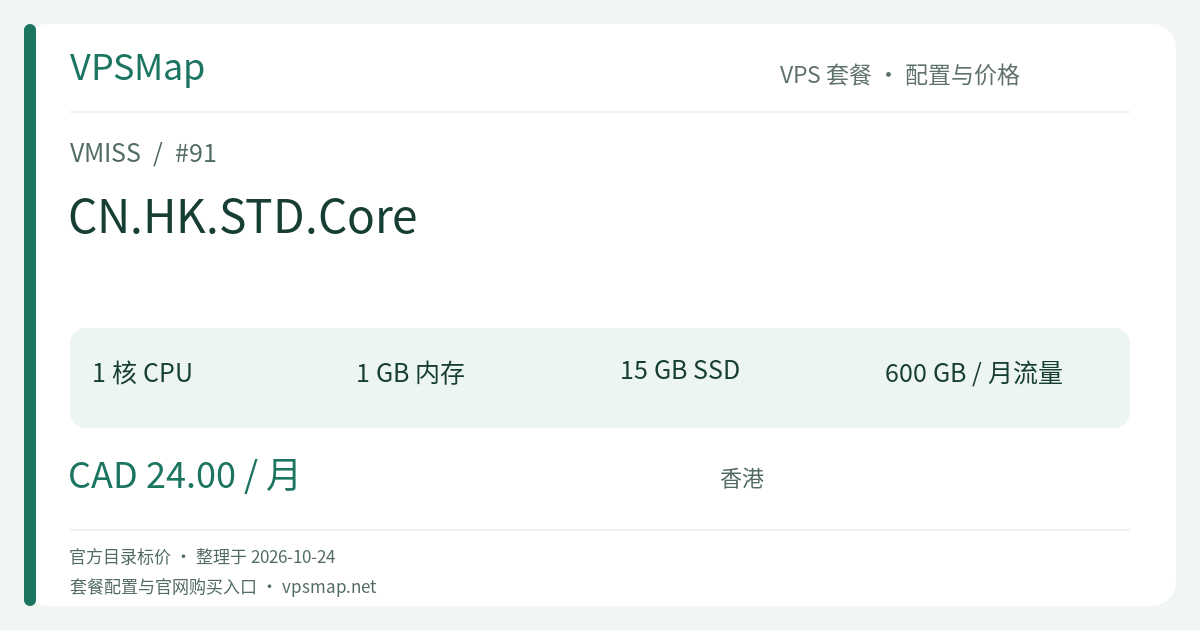
VMISS Hong Kong CN.HK.STD.Core Guide: Sizing 1 Core, 1GB RAM, and 600GB Traffic for Lean Workloads
Updated
Evaluating the Position of CN.HK.STD.Core#
Within VMISS's Hong Kong CN.HK.STD series, the Core tier priced at CAD 24/month serves as a practical intermediate stage. When provisioning infrastructure in Hong Kong, engineers often find themselves choosing between the entry-level Basic (CAD 12/month) and the roomier Pro (CAD 38/month). While Basic is budget-friendly, its 300GB monthly transfer ceiling translates to roughly 10GB per day, which can become precarious once regular container pulls, static asset delivery, and operational logging take effect. Furthermore, a 10GB system drive leaves very little breathing room after base OS packages and runtime dependencies are installed.
CN.HK.STD.Core addresses these operational pain points directly by expanding monthly traffic to 600GB (roughly 20GB daily) and providing a 15GB disk layout. For infrastructure operators seeking low physical latency into East Asia without taking on unnecessary resource overhead, Core provides the right amount of operational buffer.
Ideal Workload Scenarios#
- Edge Reverse Proxying & SSL Termination: Running Caddy or Nginx to handle TLS certificate handshakes and upstream routing back to core data centers. The 100Mbps interface handles thousands of concurrent requests smoothly.
- Independent Portfolios & Technical Documentation: Hosting static generators (Hugo, Astro) or dynamic lightweight CMS platforms (Typecho, Ghost) backed by SQLite, where 15GB easily stores assets and core software.
- Webhook Hubs & Remote Automation: Processing incoming webhooks from external CI pipelines, running event-driven automation bots, or executing localized health-check monitoring probes.
System Tuning for 1024MB RAM and 15GB Storage#
Operating reliably within a 1GB memory footprint requires deliberate configuration. A minimal Linux distribution, such as Debian 12 minimal or Alpine Linux, should be prioritized to keep idle system overhead under 150MB.
To prevent the Linux Out-Of-Memory (OOM) killer from terminating critical processes during unexpected load spikes, configuring a 1GB to 2GB swap space is highly advised upon first initialization:
# Allocate and secure a 1GB swapfile
fallocate -l 1G /swapfile
chmod 600 /swapfile
mkswap /swapfile
swapon /swapfile

# Ensure persistence across reboots
echo '/swapfile none swap sw 0 0' >> /etc/fstab
With a 15GB disk partition, log sprawl must be actively managed. When running containerized applications, configure container log rotation in /etc/docker/daemon.json:
{
  "log-driver": "json-file",
  "log-opts": {
    "max-size": "20m",
    "max-file": "3"
  }
}
Network Throughput & Bandwidth Budget#
The plan operates on a 100Mbps port interface. At wire speed, this accommodates peak theoretical speeds of roughly 12.5MB/s. A 600GB monthly traffic pool averages out to roughly 1.85Mbps of continuous round-the-clock utilization, while still allowing the system to burst up to the full 100Mbps capacity when responding to interactive visitor web sessions.
| Parameter | Specification & Operational Value |
|---|---|
| Billing Model | CAD 24 / month (standard monthly cycle) |
| Compute | 1 vCPU Core |
| Memory | 1024MB RAM (Swap recommended) |
| Disk Space | 15GB Storage |
| Monthly Transfer | 600GB (Inbound + Outbound) |
| Network Interface | 100Mbps Shared Port |
| Add-on Support | IP Replacement available at CAD 5 per event via support ticket |
Tier Comparison & Purchase Guidance#
- Downgrading to Basic: If your workload is purely passive, requires less than 300GB of monthly data, and fits inside 10GB of storage, look into CN.HK.STD.Basic at CAD 12/month.
- Upgrading to Pro: If your stack includes multi-container configurations (such as an application runtime coupled with a Redis cache and PostgreSQL daemon), the 2GB memory footprint of CN.HK.STD.Pro (CAD 38/month) will prevent memory starvation.
- Choosing Core: For standalone web services and API relays requiring reliable regional placement and adequate headroom without extra operational cost, Core remains the balanced option.
Review live availability and register your instance via the official portal: Configure VMISS CN.HK.STD.Core.