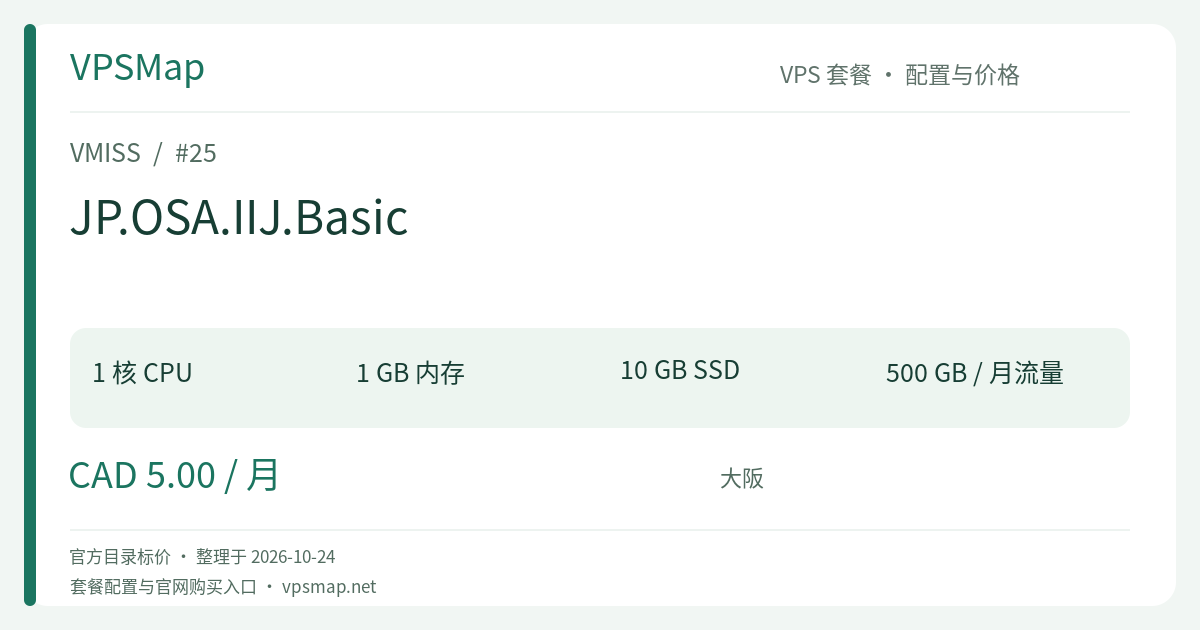
VMISS JP.OSA.IIJ.Basic Review & Guide: Entry-Level Osaka VPS at CAD 5/Month
Updated
Why Choose an Osaka IIJ Node?#
The vast majority of Japan cloud infrastructure is concentrated in the Greater Tokyo area (Kanto). If your workloads already run in Tokyo, or if your user base is spread across the Japanese archipelago and broader East Asia, simply deploying another virtual server in Tokyo leaves you vulnerable to regional single-point-of-failure risks and single-topology routing bottlenecks.
VMISS's JP.OSA.IIJ series is hosted in Osaka—the economic powerhouse of western Japan (Kansai). It features connectivity labeled under IIJ (Internet Initiative Japan), one of Japan's premier tier-1 telecommunications networks. For engineers and organizations requiring a true Kansai presence, multi-region failover, or lower edge latency into western Japan, an Osaka deployment provides distinct network topology diversification.
Within this family, JP.OSA.IIJ.Basic is the most budget-conscious tier, priced at just CAD 5 per month. Denominated in Canadian Dollars, it delivers exceptional cost efficiency for running a continuous, reliable presence in Japan.
Specifications and Resource Boundaries#
Before ordering, understand the exact technical boundaries of this instance:
- Compute: 1 vCPU
- Memory: 1024 MB (1 GB RAM)
- Storage: 10 GB
- Network Port: 500 Mbps burst port
- Monthly Traffic: 500 GB
- Billing: CAD 5.00 / month (standard monthly billing without annual lock-in)
The Upside: 500Mbps Port with Lean Elasticity#
For an entry-level tier, a 500Mbps port provides generous burst headroom. During momentary traffic spikes, asset transfers, or API synchronization passes, data won't stall behind a throttled interface. The 500GB monthly traffic pool (averaging roughly 16GB per day) is more than sufficient for lightweight daemons, monitoring nodes, or low-to-medium volume forward proxies.
The Trade-offs: 10GB Storage & 1GB Memory#
A 10GB drive is decidedly minimalist. After installing a contemporary Linux distribution (such as Debian or Ubuntu Server Minimal), around 6GB to 7GB of clean usable disk space typically remains. Consequently:
- It is not intended for hosting heavy relational databases, local video/image media, or uncontrolled application logs;
- You should deploy lean operating systems and configure proactive log rotation;
- With 1024MB RAM, running a heavy concurrent stack (e.g., MySQL 8.0 alongside Node.js and Redis) risks memory exhaustion under load. Single-purpose services run best here.
Target Use Cases: What Problem Does It Solve?#
1. Kansai Edge Reverse Proxy & Asset Caching#
Deploy an Nginx, Envoy, or Caddy gateway in Osaka to cache frequently requested static assets and terminate SSL sessions closer to users in western Japan, forwarding dynamic requests to your core infrastructure. The 500Mbps interface handles peak loads smoothly.
2. Multi-Region Network Probing & Uptime Monitoring#
Run Prometheus exporters, Uptime Kuma, or synthetic transaction probes out of Osaka to observe latency and reachability across Japanese and Asia-Pacific carriers, providing independent validation alongside your Tokyo instances.
3. Lightweight Automation, Bots & API Gateways#
Host Python/Go automation scripts, Telegram bots, webhook receivers, or e-commerce inventory sync middleware. These tasks demand minimal compute resources but benefit significantly from a stable Japanese IP and steady connectivity.
Osaka IIJ Family Comparison#
If your application outgrows the Basic tier, refer to the sibling plans in the same Osaka datacenter:
| Plan Name | vCPU | RAM | Storage | Bandwidth | Port Speed | Price (CAD) |
|---|---|---|---|---|---|---|
| JP.OSA.IIJ.Basic | 1 Core | 1024 MB | 10 GB | 500 GB | 500 Mbps | 5.00 /mo |
| JP.OSA.IIJ.Core | 1 Core | 1024 MB | 15 GB | 1000 GB | 500 Mbps | 10.00 /mo |
| JP.OSA.IIJ.Pro | 1 Core | 2048 MB | 20 GB | 1500 GB | 750 Mbps | 16.00 /mo |
| JP.OSA.IIJ.Elite | 2 Cores | 4096 MB | 40 GB | 2500 GB | 750 Mbps | 30.00 /mo |
| JP.OSA.IIJ.Ultra | 4 Cores | 8192 MB | 80 GB | 4000 GB | 1000 Mbps | 60.00 /mo |
- Basic vs. Core: If 1GB RAM meets your needs but 500GB traffic feels tight, stepping up to Core (+CAD 5/mo) doubles your data transfer to 1,000GB and expands storage to 15GB.
- Basic vs. Pro: If you intend to run containerized services or a standalone web app with an embedded database, jump directly to Pro for 2GB RAM, 750Mbps bandwidth, and 1,500GB data allowance.
Ordering & Deployment Notes#
- Billing Currency: VMISS bills officially in Canadian Dollars (CAD). When paid via credit card or standard payment methods, the exchange rate typically results in a lower net cost compared to USD-denominated servers of similar caliber.
- IP Replacement Policy: VMISS offers an official IP Replacement add-on priced at CAD 5. To replace an IP, purchase the add-on under the store's "Others" section, then open a support ticket indicating the target service ID for customer service processing.
- Stock Dynamics: VPS allocations reflect real-time infrastructure capacity on the vendor's billing portal. When in stock, activations are processed instantly upon payment.