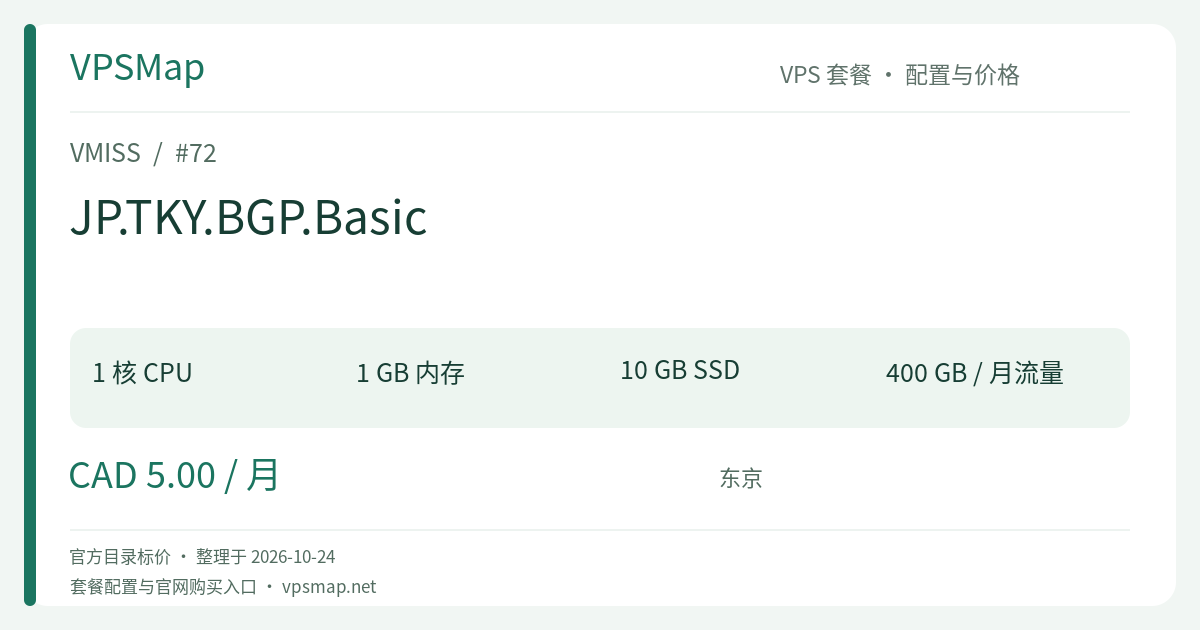
VMISS Japan Tokyo BGP Basic Buying Guide: An Affordable CAD 5/Month Lightweight Edge Node
Updated
When constructing cloud network infrastructure, not every tier requires an expensive high-specification compute instance. Numerous essential tasks—such as uptime monitoring agents, DNS forwarders, automated cron sync scripts, webhook receivers, or low-cost international testing nodes—primarily require minimal budget commitment combined with a reliable global location. The JP.TKY.BGP.Basic plan (PID: 72) from VMISS is tailored specifically for these lightweight use cases.
Priced at CAD 5 / month, this entry-level node features 1 vCPU, 1024MB (1GB) of RAM, 10GB of storage, 400GB of monthly data transfer, and a 500Mbps port profile.
Core Specs and Practical Use Cases#
1. Low-Risk CAD 5 Monthly Commitment#
At CAD 5 per month, this package delivers a frictionless cost profile. Whether deployed as a dedicated utility node by an individual developer or as a lightweight network telemetry host for an engineering team, it carries virtually no overhead burden.
- Ideal Applications:
- Uptime Kuma monitoring node or Prometheus Node Exporter;
- Lightweight Nginx or Caddy reverse proxy with automated SSL renewal;
- Telegram / Discord bot relay service;
- Scheduled data sync scripts and cron workers.
2. Resource Boundaries: 1GB RAM & 10GB Storage#
Operating within an entry-tier configuration requires sensible engineering discipline:
- Memory Management: While 1GB of RAM is insufficient for heavy Java containers or sprawling microservices, single-binary applications built in Go, Rust, or C run with remarkable efficiency. Configuring a 1GB Swap file upon provisioning is highly recommended to protect background tasks from sudden spikes.
- Storage Allocation: After installing a minimal Linux OS image, approximately 6–7GB of the 10GB drive remains available. Keep system logs concise and avoid caching unneeded container images locally.
3. 400GB Monthly Transfer on a 500Mbps Port#
The 400GB transfer quota equates to roughly 13GB of bandwidth daily, which is more than adequate for API relays, status monitoring, and lightweight web serving. The 500Mbps port ensures that package updates and script triggers complete without throttling. However, this quota is not intended for media streaming relays or bulk storage hosting.
Important Official Service Terms#
Before ordering a server in the Tokyo BGP series, keep the following official terms in mind:
- IPv6 Discontinuation: According to an official service adjustment notice issued by VMISS on June 8, 2026, IPv6 is no longer offered on the JP.TKY.BGP and JP.TKY.IIJ series, and previously provisioned complimentary IPv6 addresses were discontinued. This plan operates as an IPv4-only environment.
- IP Replacement Policy: If your workload ever requires a new IPv4 assignment, VMISS offers an official CAD 5 IP Replacement add-on available via their client portal by opening a support ticket.
Comparison Table: Tokyo BGP Product Line#
Should your memory or bandwidth demands grow, the Tokyo BGP series offers clear expansion tiers:
| Plan Name | vCPU | RAM | Storage | Bandwidth | Port Speed | Advertised Price (CAD) | Order Link |
|---|---|---|---|---|---|---|---|
| JP.TKY.BGP.Basic (Current) | 1 Core | 1024MB | 10GB | 400GB | 500Mbps | CAD 5 / mo | Order Now |
| JP.TKY.BGP.Core | 1 Core | 1024MB | 15GB | 800GB | 500Mbps | CAD 10 / mo | Order Now |
| JP.TKY.BGP.Pro | 1 Core | 2048MB | 20GB | 1200GB | 750Mbps | CAD 16 / mo | Order Now |
| JP.TKY.BGP.Elite | 2 Cores | 4096MB | 40GB | 2000GB | 750Mbps | CAD 30 / mo | Order Now |
| JP.TKY.BGP.Ultra | 4 Cores | 8192MB | 80GB | 3200GB | 1000Mbps | CAD 60 / mo | Order Now |
Selection Advice: For lightweight monitoring, personal scripts, or connectivity checks, the Basic plan (CAD 5 / month) is the most cost-effective choice. If your project expands to require a standalone database or larger runtimes, consider upgrading to JP.TKY.BGP.Pro (2GB RAM, CAD 16 / month).
Getting Started: Optimization Checklist#
- Deploy Minimal OS: Choose minimal Debian 12 upon installation; fresh boot memory usage typically remains under 80MB, leaving over 900MB for your active processes.
- Configure 1GB Swap File:
fallocate -l 1G /swapfile chmod 600 /swapfile mkswap /swapfile swapon /swapfile echo '/swapfile none swap sw 0 0' >> /etc/fstab - Maintain Log Rotation: Confirm that
/etc/logrotate.confis enabled to safeguard the 10GB filesystem from unexpected log exhaustion.
Ready to set up an affordable edge node in Tokyo? 👉 Deploy VMISS JP.TKY.BGP.Basic Instance (CAD 5 / month)