VMISS Japan Tokyo BGP Core Guide: Finding the Pragmatic CAD 10/mo Sweet Spot with 800GB Traffic and 500Mbps Port
Updated
Strategic Positioning: Relieving Traffic and Storage Constraints#
When deploying on Tokyo VPS instances, lightweight applications often encounter an awkward bottleneck: starter plans are budget-friendly, yet their 300GB to 400GB monthly bandwidth limit quickly runs thin under automated workflows, frequent webhooks, or modest proxy duties. Conversely, stepping straight up to 2GB RAM tiers significantly inflates monthly infrastructure expenditure.
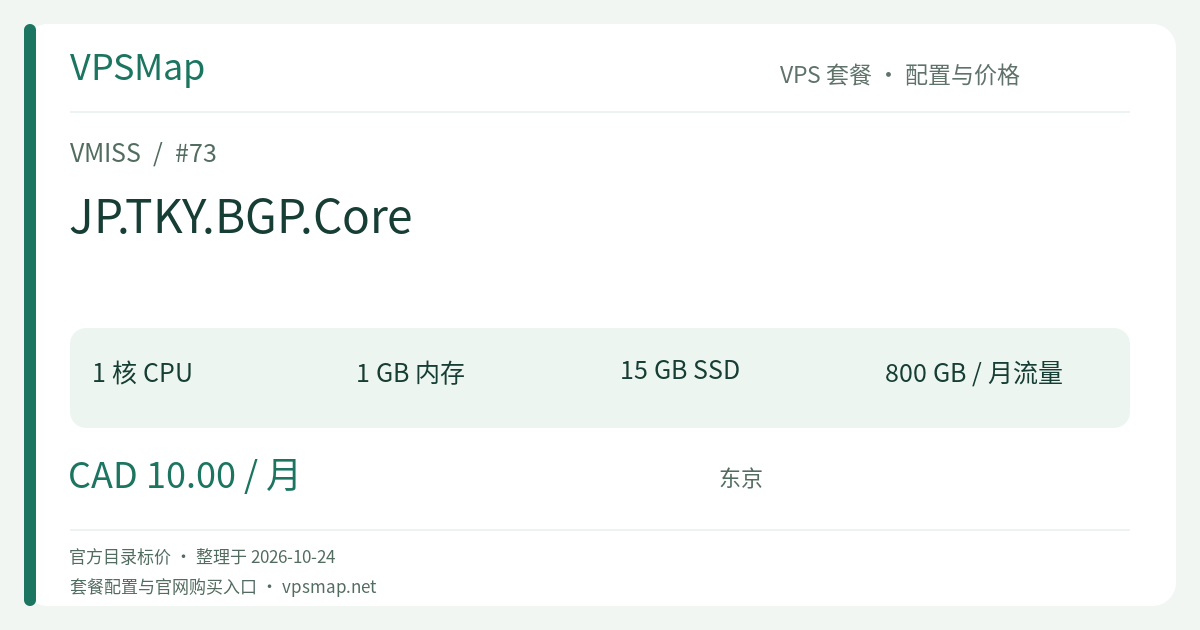
VMISS designed the JP.TKY.BGP.Core plan precisely to bridge this divide. Priced at CAD 10 / month (billed in Canadian Dollars), it maintains a streamlined 1 vCPU and 1024MB RAM footprint while doubling monthly bandwidth to 800GB, expanding disk space to 15GB, and pairing it with a 500Mbps burst port. For developers and system operators with well-defined requirements, this server eliminates unused compute overhead while granting practical breathing room for data transfer.
Resource Profile and Real-World Capacity#
| Specification | Details | Practical Workload Context |
|---|---|---|
| CPU Core | 1 vCPU | Optimized for background daemons, API relays, and asynchronous processing |
| Memory | 1024 MB (1GB) | Best paired with minimal Linux setups where service memory footprints are curated |
| Storage | 15 GB | Accommodates streamlined OS images, runtimes, and roughly 5GB–8GB of user data |
| Bandwidth | 800 GB / month | Generous ~26GB daily transfer allowance to handle regular network demand |
| Port Speed | 500 Mbps burst | Seamlessly absorbs traffic spikes and accelerated remote asset downloads |
| Base Pricing | CAD 10 / month | Billed monthly in CAD with straightforward cancel-anytime elasticity |
1. Maximizing the 1024MB Memory Footprint#
A 1GB RAM budget represents the lean standard of modern Linux servers. Operating system selection is paramount: minimal installations such as Debian 12 or Alpine Linux are strongly advised. These systems typically consume only 80MB to 150MB of memory on boot, leaving over 800MB entirely dedicated to applications.
Workloads that operate reliably on this tier include:
- Lean Reverse Proxies and Edge Gateways: Nginx, Caddy, or HAProxy handling incoming requests, SSL termination, and caching.
- Compiled Microservices: Single-binary applications built with Go, Rust, or strictly memory-capped Node.js runtimes handling API processing, webhook listeners, or automation bots.
- Monitoring Nodes: Prometheus Node Exporters, Uptime Kuma instances, and lightweight logging agents.
Scenarios to Avoid: Running unoptimized out-of-the-box MySQL 8.0 instances or complex Java runtimes is discouraged on a 1GB environment due to out-of-memory (OOM) termination risks. If your service requires persistent relational storage, opt for SQLite, tuned PostgreSQL, or an external managed database instance.
2. Putting 800GB Monthly Bandwidth to Work#
Compared to the 400GB allowance on the Basic tier, Core doubles usable bandwidth to 800GB. Across a standard 30-day billing cycle, this equates to roughly 26GB of transfer daily. Whether servicing tens of thousands of API transactions, syncing staging repositories, or managing remote container assets, this threshold offers a safe buffer against mid-month throttling.
Datacenter and Network Considerations#
VMISS is headquartered in Mississauga, Ontario, Canada. This specific instance is provisioned in their Tokyo facility under the provider-designated Tokyo BGP network routing scheme.
Two critical official operational policies must be accounted for:
- Pure IPv4 Environment: Per the provider's official policy adjustment enacted on June 8, 2026, IPv6 service is discontinued across the JP.TKY.BGP and JP.TKY.IIJ series, including all complimentary IPv6 subnets. Consequently, instances on this tier operate strictly on IPv4. Workloads mandating IPv6 routing must incorporate third-party tunneling or external edge routing.
- IP Replacement Procedure: If changing the public IPv4 address becomes necessary during operational lifecycles, VMISS offers an IP Replacement add-on priced at CAD 5. After purchasing the add-on via the billing portal, users submit a support ticket referencing the service identifier to process the modification.
Comparative Evaluation: Basic, Core, or Pro?#
The Tokyo BGP catalog follows clear, purpose-driven step-ups:
- Compared to JP.TKY.BGP.Basic (CAD 5/mo): Basic includes 1C/1G/10GB/400GB at 500Mbps. For an additional CAD 5 per month, Core provides 5GB more disk space and doubles data transfer from 400GB to 800GB. If 400GB poses operational risks for monthly workflows, Core is the most cost-effective safeguard.
- Compared to JP.TKY.BGP.Pro (CAD 16/mo): Pro doubles memory to 2048MB (2GB), elevates network port capacity to 750Mbps, and increases traffic allowance to 1200GB. When workloads require running local databases alongside application stacks, the additional 1GB of physical RAM is vital for stability.
Deployment Guidelines & Ordering#
Product availability and stock reflect real-time storefront statuses. If a tier shows sold out, monitoring the catalog for routine restocks is recommended.
- Order Direct: Purchase VMISS JP.TKY.BGP.Core (CAD 10/month)
Upon instance initialization, setting up a 1GB–2GB swap file is advisable to provide headroom during transient compilation or installation bursts. Securing SSH access and configuring local firewall rules will ensure this Tokyo VPS serves as a dependable edge host.