VMISS Japan Tokyo IIJ Core Review: Balanced Upgrade with 800GB Traffic and 15GB Storage
Updated
The Strategic Role of IIJ Core Between Basic and Pro#
When evaluating cloud VPS options in Tokyo, developers frequently encounter an uncomfortable trade-off:
- Opting for the ultra-affordable Basic tier (CAD 5/month) keeps costs at a minimum. However, its 10GB storage can quickly become cramped after provisioning the OS and container runtimes, leaving only a couple of gigabytes for logs and data. Furthermore, 500GB of traffic might feel restrictive if your node performs active synchronization or reverse proxying.
- Upgrading directly to the Pro tier (CAD 16/month) doubles the memory to 2GB, but more than triples the monthly commitment compared to Basic. For workloads that do not require heavy computation but simply need more disk space and bandwidth, this can be an unnecessary leap in budget.
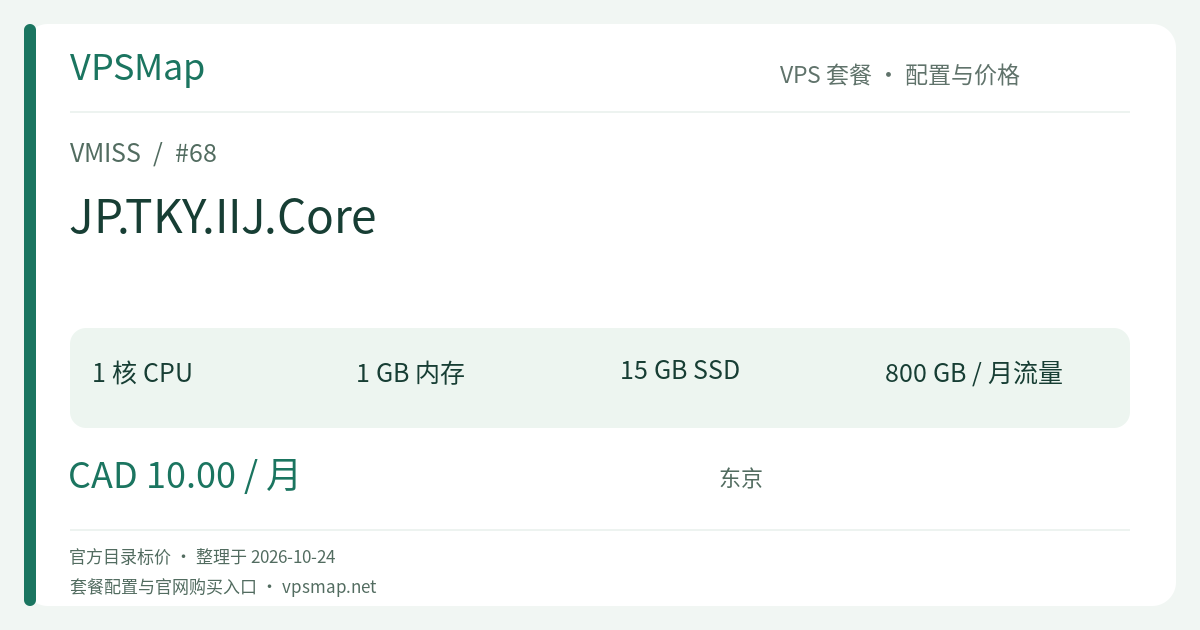
To bridge this exact gap, VMISS provides JP.TKY.IIJ.Core. Priced at a moderate CAD 10 per month, it maintains the efficient 1 vCPU and 1GB RAM foundation while expanding storage to 15GB SSD and bandwidth to 800GB monthly traffic. It serves as an ideal sweet spot for small, continuous workloads.
Practical Advantages of 15GB Disk and 800GB Bandwidth#
Hardware & Network Specification Summary#
- Compute: 1 vCPU core
- RAM: 1,024 MB (1GB)
- Storage: 15 GB SSD (a 50% increase over Basic)
- Monthly Bandwidth: 800 GB / month (a 60% increase over Basic, bi-directional)
- Port Speed: 500 Mbps uplink
- IP Allocation: 1 Dedicated IPv4 (Note: Following the official June 2026 network adjustment, IPv6 has been permanently removed from Tokyo IIJ nodes)
- Price: CAD 10 / month
The Operational Relief of 5GB Extra Storage#
In day-to-day Linux server administration, the difference between 10GB and 15GB of disk space is substantial:
- Base operating system images require between 2GB and 3GB.
- Docker Engine and core container layers typically demand 1GB to 1.5GB.
- On a 10GB drive, usable free space hovers around 5GB. Pulling a couple of container images or accumulating several weeks of logs can push utilization past 80%, raising the risk of disk write failures.
- With 15GB SSD storage, your effective free space nearly doubles to roughly 10GB. You gain the buffer needed to retain local application logs, host an active SQLite database with tens of thousands of records, and maintain kernel packages without constant disk housekeeping.
26GB Daily Bandwidth Buffer#
An 800GB monthly data allowance provides roughly 26.6GB of data transfer every day. For applications distributing assets, syncing document repositories, or handling multi-site reverse proxy routing, this capacity easily absorbs standard web crawlers and irregular traffic spikes without mid-month quota panic.
Prime Use Cases for IIJ Core#
Personal Productivity Tools & Light Backends Host lightweight backend stacks like Vaultwarden, Miniflux RSS reader, or Joplin Sync Server paired with SQLite or embedded storage. 1GB of RAM easily runs these daemons, while 15GB of disk and 800GB of bandwidth provide reliable storage persistence and continuous multi-device sync.
Moderate-Traffic API Forwarding & Webhook Relays Act as an edge API router connecting regional microservices across East Asia. The 500Mbps port delivers immediate packet transmission, and the 800GB quota seamlessly handles millions of lightweight REST requests and log callbacks each month.
Multi-Site Reverse Proxy with Local Asset Caching Utilize a portion of the 15GB disk as a local Nginx proxy cache, serving static assets (images, stylesheets, JavaScript) locally in Tokyo to accelerate page load times for East Asian visitors.
Tier Sizing: Basic vs Core vs Pro#
To help you pinpoint the right configuration, compare the three key entry tiers in the IIJ series:
| Specification | JP.TKY.IIJ.Basic | JP.TKY.IIJ.Core (This Plan) | JP.TKY.IIJ.Pro |
|---|---|---|---|
| Monthly Price | CAD 5 / mo | CAD 10 / mo | CAD 16 / mo |
| vCPU | 1 Core | 1 Core | 1 Core |
| RAM | 1024 MB | 1024 MB | 2048 MB (2x) |
| Storage | 10 GB | 15 GB (+50%) | 20 GB |
| Monthly Bandwidth | 500 GB | 800 GB (+60%) | 1500 GB |
| Port Speed | 500 Mbps | 500 Mbps | 750 Mbps |
| Primary Fit | Minimal sandbox, personal tunnel, simple probe | Balanced light production, eliminates disk and bandwidth panic | Memory-intensive apps, MySQL, full container stacks |
Sizing Advice:#
- Choose Basic (CAD 5/mo) if budget is your sole criteria and you only need a temporary dev sandbox, a lightweight uptime probe, or an ad-hoc proxy.
- Choose Core (CAD 10/mo) if you plan to run permanent background services and want reliable disk headroom and generous data transfer without daily maintenance anxiety.
- Choose Pro (CAD 16/mo) if your software stack requires more than 1GB of memory (such as WordPress with MySQL or a Java runtime), since Core maintains the same 1GB memory allocation as Basic.
Important Network & Service Parameters#
- IPv4-Only Connectivity: A single dedicated IPv4 address is assigned. Per VMISS official notices, IPv6 is no longer offered on Tokyo IIJ nodes.
- IP Replacement Add-on: If an IP replacement is ever needed, VMISS offers an official add-on service at CAD 5 per replacement, activated via support ticket.
- System Best Practice: Configure a 1GB swap file and enforce SSH key-based authentication with
fail2banfor production security.
Final Recommendation#
VMISS JP.TKY.IIJ.Core hits the precise threshold needed for lightweight production hosting in Tokyo. Rather than inflating computational costs unnecessarily, it directs its incremental budget to the two areas that most directly improve system stability: 5GB more disk space and 300GB more monthly traffic.
If you want an affordable, responsive Tokyo VPS with a fast 500Mbps port that frees you from continuous disk monitoring, CAD 10/month for the IIJ Core represents a pragmatic, dependable investment.
👉 Order VMISS JP.TKY.IIJ.Core (PID 68) on the Official Store