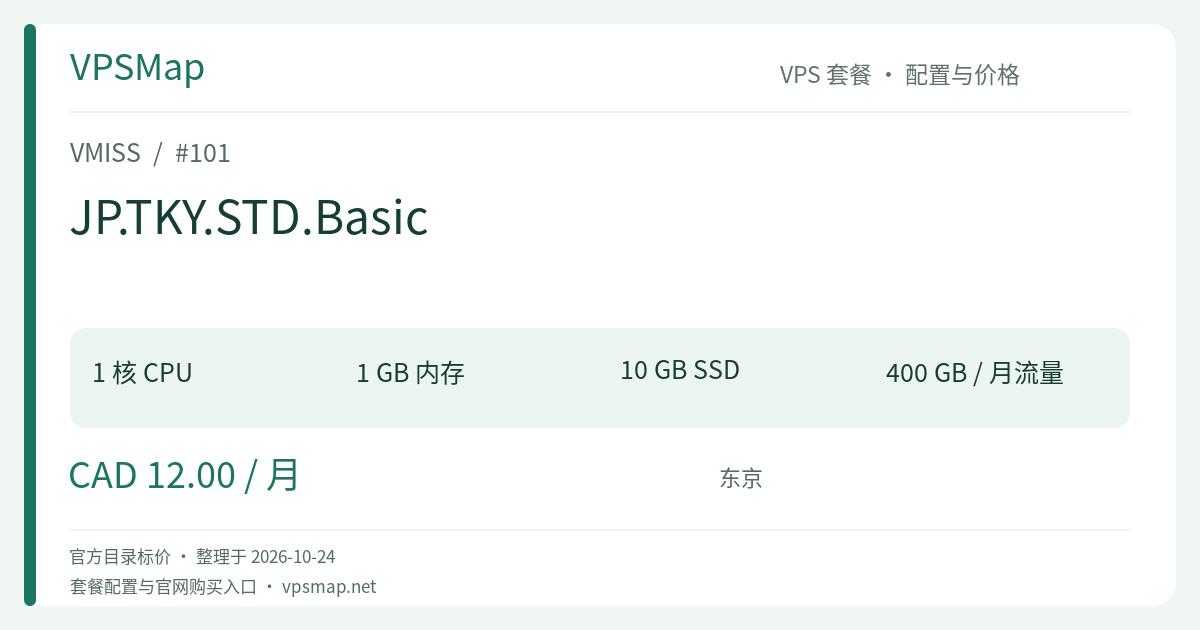
VMISS Tokyo JP.TKY.STD.Basic Review & Guide: Lightweight Asia-Pacific Deployment at CAD 12/Month
Updated
What JP.TKY.STD.Basic Solves Best#
When architecting infrastructure across the Asia-Pacific region, Tokyo data centers have always served as a critical hub due to regional peering and geographical proximity. The JP.TKY.STD.Basic instance from VMISS offers an accessible gateway into a dedicated Tokyo environment priced at an approachable CAD 12/month on a flexible monthly cycle.
This entry-level instance is built for targeted, low-overhead workloads. Instead of locking budget into annual commitments or over-provisioned hardware, developers receive a reliable, independent computing instance. Whether you need a dedicated telemetry endpoint, a regional webhook forwarder, an uptime monitor, or a lean static web server, JP.TKY.STD.Basic delivers isolated execution without unnecessary complexity.
Resource Allocation & Workload Expectations#
Here is a detailed breakdown of the official hardware specifications:
| Specification | Allocation |
|---|---|
| vCPU | 1 Core |
| System Memory | 1024 MB (1 GB) |
| Disk Storage | 10 GB |
| Network Port | 100 Mbps |
| Monthly Traffic | 400 GB |
| Network Zone | jp-tokyo-std (Tokyo Standard) |
| Reference Price | CAD 12 / Month |
1. Memory Headroom (1024MB RAM)#
While 1GB of RAM cannot sustain heavy enterprise stacks like broad microservice arrays or memory-hungry JVM frameworks, it is exceptionally capable for modern lean development:
- Ideal tasks: Single-binary applications compiled in Go or Rust; micro-framework APIs running on Python (FastAPI/Flask) or Node.js; reverse proxies such as Caddy or Nginx; lightweight SQLite-backed web apps.
- Constraints: Avoid co-locating resource-heavy database engines on the same node; leverage managed cloud databases or remote storage when persistence needs grow.
2. Disk Management (10GB Storage)#
The 10GB SSD footprint requires deliberate disk governance. After installing a minimal Linux distribution (like Debian or Alpine), approximately 7GB to 8GB remains available for application code and runtimes:
- Perfectly suited for headless worker scripts and static assets.
- User uploads and heavy application artifacts should be offloaded directly to external S3-compatible object storage.
3. Port Speed & Traffic (100Mbps / 400GB)#
A 400GB monthly bandwidth allowance translates to approximately 13GB per day. Combined with a 100Mbps port ceiling, this capacity easily handles continuous API requests, status checks, and steady web traffic without throttling.
Practical Optimization Tips for 1GB Instances#
To ensure dependable operation and eliminate Out-of-Memory (OOM) termination risks, we recommend applying several foundational setup practices:
1. Configure a Swap Buffer#
A modest swap file safeguards mission-critical processes during package updates (apt upgrade) or occasional concurrency spikes:
# Allocate 1GB swap file with restrictive permissions
sudo fallocate -l 1G /swapfile
sudo chmod 600 /swapfile
sudo mkswap /swapfile
sudo swapon /swapfile

# Configure swappiness so swap is only tapped under genuine memory pressure
echo 'vm.swappiness=15' | sudo tee -a /etc/sysctl.d/99-swap.conf
sudo sysctl -p /etc/sysctl.d/99-swap.conf
2. Restrict System Log Growth#
With 10GB of storage, unbounded log retention is a common failure mode. Limiting systemd-journald usage prevents sudden disk exhaustion:
# Cap systemd logs at 100MB
sudo mkdir -p /etc/systemd/journald.conf.d
cat << 'EOF' | sudo tee /etc/systemd/journald.conf.d/size-limit.conf
[Journal]
SystemMaxUse=100M
RuntimeMaxUse=50M
EOF
sudo systemctl restart systemd-journald
3. Deploy Lightweight Gateways#
For TLS automation and traffic routing, Caddy or a lean build of Nginx is strongly advised. Caddy handles automatic Let's Encrypt certificates out-of-the-box with a minimal idle memory footprint.
Lineup Evaluation: When to Keep Basic vs. Upgrade#
The VMISS Tokyo Standard catalog offers structured upward tiers:
- JP.TKY.STD.Basic (CAD 12/mo): 1 vCPU / 1GB RAM / 10GB Disk / 400GB Bandwidth / 100Mbps
- JP.TKY.STD.Core (CAD 24/mo): 1 vCPU / 2GB RAM / 15GB Disk / 800GB Bandwidth / 100Mbps
- JP.TKY.STD.Pro (CAD 38/mo): 1 vCPU / 3GB RAM / 20GB Disk / 1200GB Bandwidth / 200Mbps
Choose JP.TKY.STD.Basic if:
- Your application is a self-contained microservice, API bridge, or monitoring agent.
- Steady-state application memory usage remains under 600MB.
- You do not require local database hosting or intensive local container builds.
If your service stack expands to include multi-container orchestration or requires more than 400GB of monthly transfer, transitioning to the 2GB Core plan provides an effortless expansion path.
Ordering & Service Details#
- Billing Structure: Transparent monthly billing at CAD 12/month with no mandatory long-term commitment.
- Direct Purchase Link: Order VMISS JP.TKY.STD.Basic.
- IP Replacement Add-on: Should you require an IP reassignment in the future, VMISS provides an official CAD 5 IP Replacement add-on (payable via client area, followed by submitting a support ticket detailing the instance).