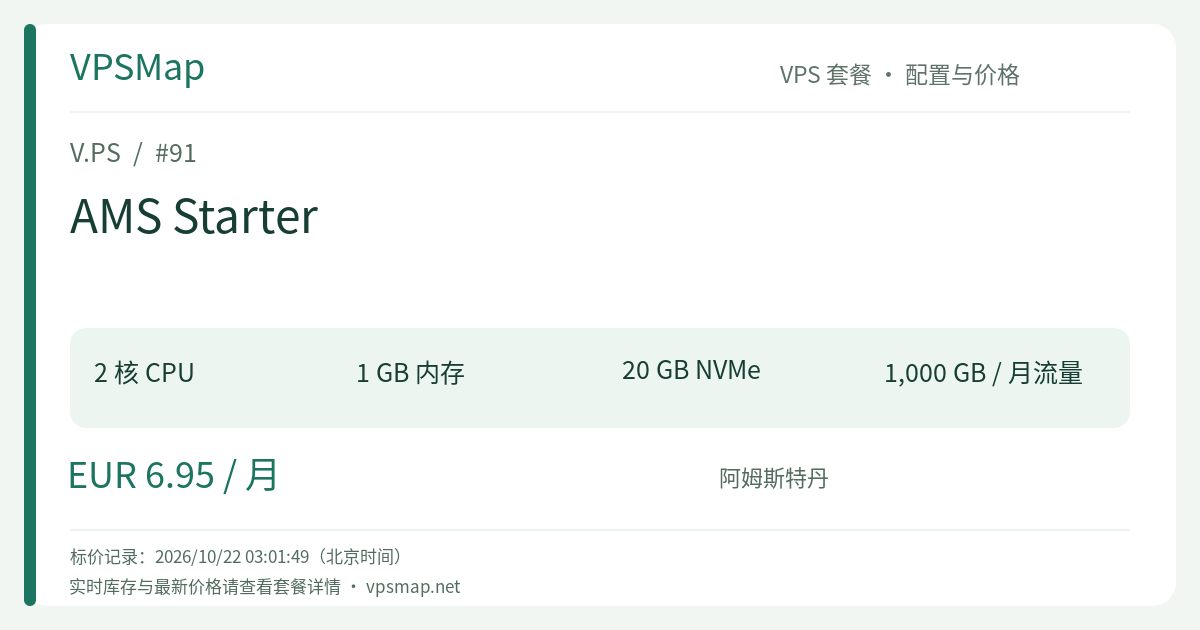
V.PS Amsterdam Cloud AMS Starter Review: A €6.95/mo Lightweight Gateway in Europe's Network Hub
Updated
Why Amsterdam Anchors European Infrastructure#
For engineers and digital businesses targeting the European continent, Amsterdam stands out as the ultimate strategic crossroads. Home to AMS-IX—one of the planet's busiest and most interconnected internet exchange points—the Dutch capital connects seamlessly with Tier 1 transit providers, hyperscale cloud fabrics, and content distribution networks. Latency into Germany, France, the UK, the Nordics, and Eastern Europe remains exceptionally low.
Within this premier data hub, V.PS (backed by carrier-grade infrastructure provider xTom) delivers its Cloud AMS Starter instance. At €6.95 per month, it combines standard KVM virtualization with performant NVMe storage and full 1 Gbps network connectivity.
AMS Starter Hardware & Network Specifications#
| Specification | Details |
|---|---|
| vCPU | 2 Cores |
| Memory | 1 GB RAM |
| Storage | 20 GB NVMe SSD |
| Monthly Bandwidth | 1 TB @ 1 Gbps Port |
| IP Allocation | 1 Dedicated IPv4 + 1 Dedicated IPv6 |
| Pricing | €6.95 / month |
| Management | netboot.xyz ISO support, Web console reinstall/rescue, 99.9% SLA |
Unlike conventional entry-tier cloud droplets that restrict users to a single core and sluggish mechanical or SATA drives, the AMS Starter plan provides 2 vCPU cores paired with NVMe solid-state storage. This architectural advantage prevents background maintenance tasks, SSL negotiations, or bursty package installations from monopolizing your compute cycles.
Realistic Production Use Cases#
With 1 GB of memory, optimal utility comes from running focused, resource-efficient workloads:
- Edge Gateways & Reverse Proxies: Deploy Caddy or Nginx to handle SSL termination, caching, and request routing for European audiences. The 1 Gbps uplink effortlessly absorbs transient visitor spikes.
- Lightweight Microservices & Webhook Workers: Go, Rust, and modern lightweight Node.js daemons typically consume under 150 MB of memory, leaving plenty of room for operational stability.
- Personal DevOps Utilities & DNS Resolvers: Host private WireGuard peers, internal automation scripts, or recursive DNS resolvers (like AdGuard Home or Unbound) situated right next to major exchange points.
- Cross-Border Application Relays: If your backend systems communicate frequently with European REST/GraphQL APIs, collocating integration workers in Amsterdam reduces network round-trip time significantly.
Key Trade-Offs to Keep in Mind#
- 1 GB RAM Limits: While running lightweight Docker containers is viable, configuring a 1GB–2GB swap file is good operational practice. If your workload involves heavy database engines like PostgreSQL or full-stack PHP/Java applications, step up to the 2 GB AMS Essential tier.
- Network Characteristics: V.PS Amsterdam delivers premium Tier 1 European transit and direct exchange peering (AMS-IX, DE-CIX). It is engineered for European and global connectivity, not specialized Chinese routing optimizations (such as CN2 GIA).
- Disk Space: 20 GB NVMe is plenty for minimal OS images and production binaries, but unsuited for bulk media storage or archival dumps. Leverage S3-compatible object storage or explore V.PS Storage KVM options for heavy data footprints.
Ordering and Setup Guide#
- Access the Portal: Open the V.PS Official Portal.
- Select the Plan: Navigate to Deploy / Cloud KVM VPS, select location Europe -> Amsterdam (AMS), and pick AMS Starter (€6.95 / mo).
- Operating System: Choose standard Debian, Ubuntu LTS, CentOS Stream, Rocky Linux, or AlmaLinux. Custom distributions can be booted post-deployment via netboot.xyz.
- Account Information: Accurate billing contact details are required to pass the automated fraud review.
- Checkout: Complete payment via PayPal, credit card, or supported local checkout gateways.
Refund Policy Highlights: A 14-day money-back guarantee applies strictly to your first eligible VPS refund, provided data usage remains under 10 GB, no BGP/IX add-ons were attached, no IP blacklisting occurred, and standard payment channels (non-crypto, non-wire) were utilized.