V.PS Tokyo Cloud KVM NRT Starter Review: Dual-Core NVMe Compute in Tokyo for €6.95/mo
Updated
Why Developers Need an Agile Edge Node in Tokyo#
For independent developers, DevOps engineers, and teams requiring low-latency API gateways, the Tokyo datacenter landscape holds strategic importance: close proximity to major Asia-Pacific economic centers, dense submarine fiber termination, and mature routing backbones. However, traditional hyperscalers in this region present two major obstacles: prohibitive pricing with aggressive egress traffic fees, or budget instances that throttle compute with a single anemic vCPU core that chokes during simple package upgrades.
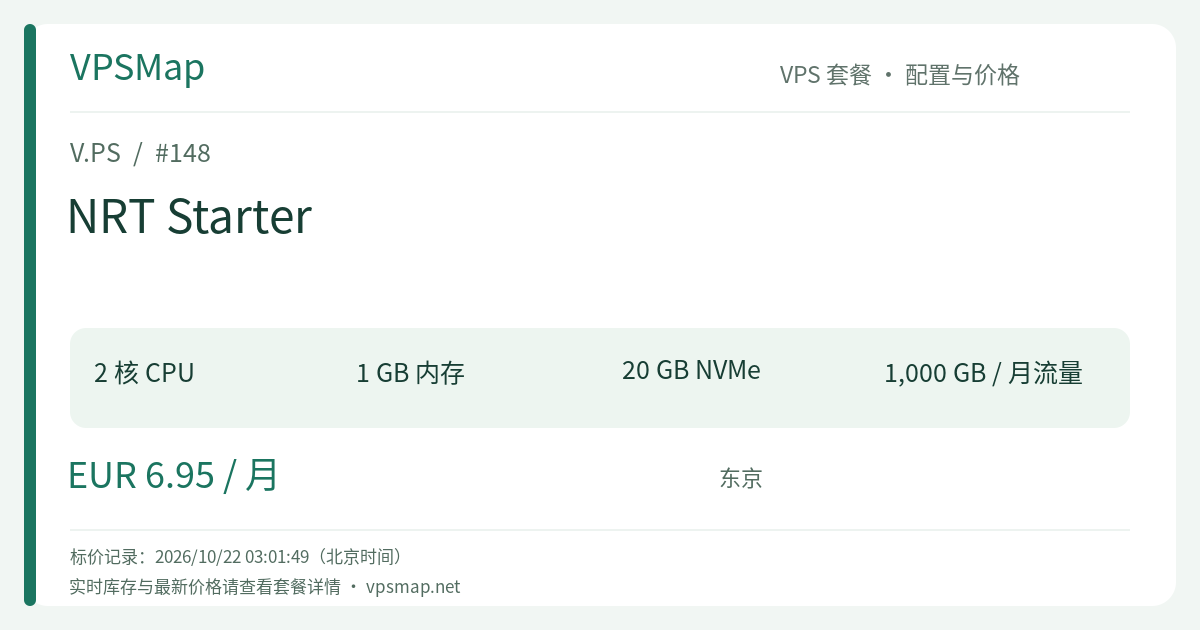
Operated by the infrastructure team at xTom, V.PS delivers an effective solution in its Tokyo facility: the Cloud KVM VPS - NRT Starter plan. Priced at €6.95/month, this configuration packs 2 CPU cores, 1GB RAM, 20GB NVMe storage, 1TB monthly bandwidth on a 1Gbps port, and dual-stack public IPv4 and IPv6 addresses.
This guide breaks down the technical value of the NRT Starter, details its ideal engineering workloads, and provides practical system-level optimization advice for operating smoothly on 1GB of memory.
Technical Specifications and Architectural Value#
| Specification | Configuration | Practical Engineering Benefit |
|---|---|---|
| vCPU | 2 Cores | Unlike common single-core budget VPSs, dual cores prevent SSH lockups during package installations and accelerate compilation tasks. |
| RAM | 1024 MB (1GB) | Optimized for CLI-driven workloads, lightweight microservices, and reverse proxies. Java/Node stacks will require swap or tier upgrades. |
| Storage | 20 GB NVMe | Ultra-low access latencies and high random IOPS ensure rapid boot cycles, snappy cache operations, and zero disk bottlenecks. |
| Data Transfer | 1,000 GB (1TB) / mo | Generous allocation easily supporting moderate website traffic, API proxies, and monitoring agents. |
| Network Port | 1 Gbps | High-bandwidth burst headroom mitigates connection queuing during traffic spikes. |
| IP Allocation | 1 IPv4 + 1 IPv6 | Native dual-stack support ready for modern IPv6 transit and developer testing. |
| Billing | €6.95 / month | Straightforward monthly billing with no long-term contractual lock-in. |
1. The Dual-Core Advantage on a Budget Instance#
The most persistent headache with ultra-cheap VPS providers is not always memory shortage, but single-threaded CPU contention. When running apt update && apt upgrade or unpacking compressed archives, a single core hits 100% load, freezing interactive SSH sessions. The NRT Starter mitigates this by provisioning 2 CPU cores, allowing one thread to absorb background I/O or compilation while the other guarantees responsive administrative access.
2. Pure NVMe Performance#
Many low-cost instances still rely on legacy spinning rust or oversold SATA SSD pools. V.PS equips its Cloud KVM instances with NVMe storage. From OS reboots and Docker layer extractions to read/write transactions on embedded engines like SQLite or BoltDB, disk I/O stays consistently performant.
3. Backbone Routing and 99.9% SLA#
Leveraging xTom's extensive transit network and direct peering at major Internet Exchange Points (including DE-CIX, AMS-IX, and LocIX), V.PS guarantees a 99.9% SLA across its network. Potential buyers can verify real-time routing and latency via the official Looking Glass tool before placing an order.
Target Use Cases for NRT Starter#
The NRT Starter is not engineered for heavy distributed clusters; its ideal niche is as an agile, low-latency edge node in Asia-Pacific:
- Personal Web and Edge Gateways: Host static generators (Nginx/Caddy serving Hugo or Astro), personal tech blogs, or edge caching layers.
- Compiled Microservices and Bots: Microservices written in Go, Rust, or C, background cron jobs, and chat automation bots (Telegram/Discord) operating with small memory footprints.
- Network Probes and Private Tunneling: Deploy monitoring collectors like Uptime Kuma or Prometheus node exporters, or run private network relays using WireGuard, Tailscale DERP, or FRP.
- API Integration Relays: Route third-party SaaS integrations that mandate verified Asia-Pacific IP geographic origin.
Performance Optimization on 1GB RAM#
To ensure reliable uptime on a 1GB footprint, applying basic memory management is recommended immediately upon provisioning:
Step 1: Initialize Swap Space on Fast NVMe#
Prevent unexpected kernel Out-Of-Memory (OOM) kills during temporary workload spikes by allocating an NVMe swap file:
# Allocate a 1GB swapfile
sudo fallocate -l 1G /swapfile
sudo chmod 600 /swapfile
sudo mkswap /swapfile
sudo swapon /swapfile

# Persist across reboots in fstab
echo '/swapfile none swap sw 0 0' | sudo tee -a /etc/fstab

# Configure swappiness to favor physical RAM
sudo sysctl vm.swappiness=10
echo 'vm.swappiness=10' | sudo tee -a /etc/sysctl.conf
Step 2: Enforce Container Resource Bounds#
When utilizing Docker, avoid unconstrained memory allocation. Set memory limits explicitly in your docker-compose.yml:
version: '3.8'
services:
  app:
    image: my-service:latest
    restart: unless-stopped
    deploy:
      resources:
        limits:
          memory: 256M
        reservations:
          memory: 64M
Tier Comparison: NRT Starter vs. NRT Essential#
Directly above the Starter plan sits the NRT Essential:
| Specification | NRT Starter | NRT Essential |
|---|---|---|
| Price | €6.95 / mo | €7.95 / mo |
| CPU | 2 Cores | 2 Cores |
| Memory | 1 GB | 2 GB (2x capacity) |
| NVMe Disk | 20 GB | 30 GB (+10GB) |
| Bandwidth | 1TB on 1Gbps | 1TB on 1Gbps |
Evaluation Insight: For a delta of just €1.00/month, NRT Essential doubles your memory capacity to 2GB. If your stack is strictly minimal (Go/Rust/Caddy), the Starter is the most economical deployment. However, if your plans include full Docker Compose stacks with relational databases and Node.js runtimes, the €1 upgrade to Essential will eliminate memory ceiling concerns.
Ordering Walkthrough and Policy Guidelines#
To ensure swift provisioning and prevent account flag triggers, follow this ordering procedure:
- Portal Entry: Go to the official portal via V.PS Home. This registers your session with affiliate credit and lands on the main store.
- Product Selection: Click Deploy a Server or navigate to Cloud KVM VPS, then select Tokyo (NRT).
- Plan Configuration: Locate NRT Starter and click Order.
- System Selection: Choose your preferred Linux distribution (Debian Stable, Ubuntu LTS, CentOS Stream, Rocky Linux, AlmaLinux) or load custom images via netboot.xyz ISO. Configure your server hostname and paste your SSH public key.
- Anti-Fraud Requirements: Enter your legitimate legal name and verifiable residential address. V.PS mandates genuine billing records; utilizing rotating proxy addresses or fraudulent credentials triggers automated rejection and order cancellation.
- Payment Options: Complete billing using PayPal, credit cards, bank transfer, or regional gateways such as Alipay, iDEAL, or Bancontact.
- Service Activation: The instance provisions automatically following invoice clearance. The web console provides instant reboot, rebuild, and SLA telemetry controls.
Official Refund Terms#
- 14-Day Window: KVM VPS purchases are eligible for a refund ticket request within 14 calendar days, restricted to one refund per customer account.
- Exclusion Conditions: Refunds cannot be granted if data transfer exceeds 10 GB, if BGP/IX services are attached, if the service was transferred between accounts, if the IP address received abuse flags or blacklist entries (Spamhaus, blocklist.de, GFW), or if an IP replacement was completed. Cryptocurrency and bank transfer payments are non-refundable.
Final Verdict#
If you need an agile, high-speed compute instance in Tokyo with modern NVMe storage and dual-core responsiveness—without long-term annual contracts—the V.PS NRT Starter delivers strong fundamentals at €6.95/month.
Deploy your Tokyo node now: 👉 Deploy V.PS Tokyo NRT Starter on Official Portal