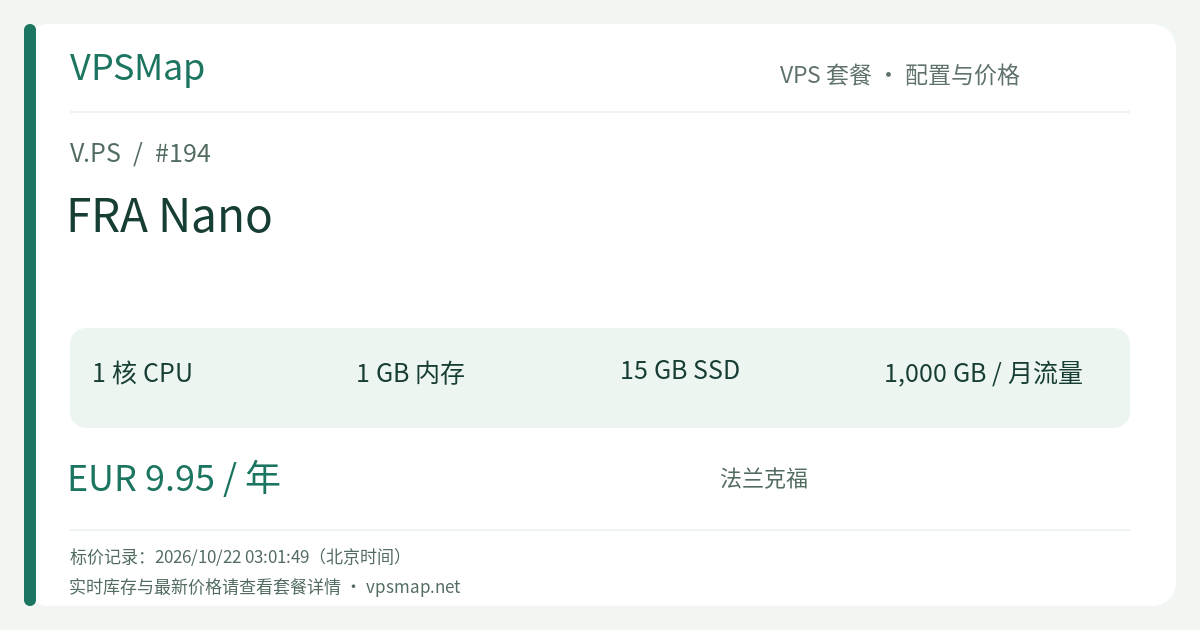
V.PS Frankfurt FRA Nano Review: The €9.95/Year 1 Gbps Dual-Stack European Micro Server
Updated
Why Anchoring a Permanent Micro Node in Europe Matters#
For systems engineers, software developers, and independent creators, having a permanent presence in a major European network interchange is invaluable. Whether you need independent observability into overseas network paths or an ultra-low-overhead node to run your management scripts, a reliable micro instance is often the smartest architectural addition you can make.
V.PS (operated by the global network carrier xTom) offers its FRA Nano plan in Frankfurt, Germany, with an annual price of just €9.95 per year (equivalent to roughly €0.83 per month). In an era where most cloud platforms enforce complex hourly billing with rising entry thresholds, securing a persistent, full-featured KVM virtual private server for under ten euros a year represents outstanding value.
Crucially, Frankfurt is not just a major financial center; it is home to DE-CIX, one of the world's highest-volume internet exchanges. Backed by xTom's Tier-1 transit and premium European peering fabric, this micro machine features a full 1 Gbps burst port alongside one dedicated IPv4 address and one native IPv6 address. It is an uncompromising network package at an entry-level price point.
Specifications & Architectural Snapshot#
Here is what the FRA Nano package provides on paper:
| Specification | Details |
|---|---|
| vCPU Cores | 1 vCPU (KVM Virtualization) |
| System Memory | 1024 MB (1 GB) RAM |
| Disk Storage | 15 GB SSD Storage |
| Monthly Bandwidth | 1000 GB (1 TB) Bi-directional Transfer |
| Port Speed | 1 Gbps Burst Port |
| IP Allocation | 1 Dedicated IPv4 + 1 Native IPv6 |
| SLA & Uptime | 99.9% Network SLA Across Range |
| Pricing | €9.95 / year (Single yearly billing cycle) |
Many rock-bottom budget VPS offerings cripple networking by capping speeds at 100 Mbps, putting instances behind carrier-grade NAT, or neglecting IPv6 entirely. V.PS FRA Nano stands out by delivering an unthrottled 1 Gbps port and dual-stack native addressing. System updates, package downloads, and outbound API calls won't choke on narrow physical pipes.
Practical Deployments: What Can You Run with 1GB RAM & 15GB SSD?#
A cheap server is only valuable if it solves real problems rather than sitting idle. While a single-core, 1GB RAM instance cannot run monolithic enterprise workloads, it is ideal for highly focused micro-services:
1. Distributed Observability & Uptime Monitoring (Uptime Kuma / Node Exporter)#
When running customer-facing web services or APIs, single-location monitoring causes blind spots and false alarms. Placing an Uptime Kuma instance or a Prometheus Blackbox Exporter in Frankfurt provides an authoritative European vantage point. Track HTTP latency, SSL certificate expirations, DNS health, and TCP reachability around the clock with zero noise.
2. Edge Reverse Proxies & Lightweight Web Delivery (Caddy / Nginx)#
Position Caddy or Nginx at the edge to serve static websites or act as an encrypted frontend for backend APIs. With 1 Gbps throughput, it handles TLS handshakes and automated certificate provisioning via Let's Encrypt smoothly, accelerating content delivery for European audiences.
3. Automation Daemons & Webhook Hubs (Bots & Scheduled Jobs)#
Host your continuous Telegram alert bots, Discord notifications, GitHub Webhook routers, or automated Python/Node.js maintenance scripts. These background tasks typically consume between 30 MB and 120 MB of resident memory, fitting comfortably within the 1 GB physical memory footprint.
4. Secure Administrative Bastion & WireGuard Mesh Node#
Exposing production servers directly to public SSH scanning is poor practice. Use FRA Nano as a locked-down SSH bastion host fortified with public key authentication and Fail2ban. It also makes a superb endpoint for WireGuard or Tailscale meshes, linking your remote workstations and home labs securely.
5. Private DNS Resolver & Ad-Blocking Relay#
Run a lightweight Unbound resolver or a compact AdGuard Home instance (with optimized logging) to provide clean, encrypted DNS-over-HTTPS (DoH) lookups for your portable devices when roaming abroad.
Realistic Constraints & Workload Tradeoffs#
High-density computing requires setting realistic expectations. The FRA Nano is engineered for lightweight workloads, and buyers should keep the following boundaries in mind:
- 15GB SSD Capacity: After installing Debian 12 or Ubuntu LTS, approximately 11 GB to 12 GB remains usable. This plan is not suitable for uncompressed media archives, unpruned Docker registries, or heavy transactional databases without log rotation.
- 1GB RAM Discipline (Enable Swap): Running unoptimized databases like default MySQL 8.0 alongside heavy web servers can trigger out-of-memory (OOM) errors. Always allocate a 1 GB to 2 GB swap file during system initialization, and favor memory-efficient engines like SQLite or Alpine-based containers.
- Shared CPU Baseline: The single vCPU core operates on a fair-share model. It excels at handling bursts, network I/O, and event loops, but sustained 100% CPU utilization (e.g., continuous video transcoding or coin mining) violates acceptable use terms and will be throttled.
Plan Comparison: FRA Nano vs. FRA Nano Pro#
If your requirements extend beyond basic monitoring or jumpbox duties, consider the companion plan available in the same Frankfurt facility:
| Specification | FRA Nano (Current Plan) | FRA Nano Pro (Step-Up) |
|---|---|---|
| Annual Cost | €9.95 / year | €19.95 / year |
| RAM | 1 GB RAM | 2 GB RAM (2x) |
| Storage | 15 GB SSD | 30 GB SSD (2x) |
| Bandwidth | 1000 GB (1 TB) | 2000 GB (2 TB) (2x) |
| Port Speed | 1 Gbps | 1 Gbps |
| Best For | Probes, jumpboxes, and bots | Full Docker Compose stacks & web apps |
If you want the absolute minimum cost to maintain an active European network point, the FRA Nano is unmatched. If you want the breathing room to host multi-container stacks like Vaultwarden and Ghost simultaneously, spending the extra €10 annually on the Nano Pro is the wiser choice.
Step-by-Step Purchase & Setup Walkthrough#
To ensure proper affiliate attribution and a seamless setup experience, follow these steps:
- Access the Platform: Visit the Official V.PS Portal. This initial entry point sets your session cookies correctly before redirecting to the main catalog;
- Navigate to Deployment: Click Deploy a Server in the upper navigation bar or head into the Nano KVM VPS section;
- Select Datacenter & Tier: Select Europe - Frankfurt (FRA), then click Order on the FRA Nano tier (€9.95 /yr);
- Choose OS & Credentials: Select from Debian Stable, Ubuntu LTS, AlmaLinux, Rocky Linux, or CentOS Stream (netboot.xyz is also available for custom ISO boots). Paste your SSH public key into the configuration field to ensure passwordless, secure root access out of the box;
- Anti-Fraud Billing Compliance: V.PS protects its IP ranges through strict anti-fraud checks. You must enter your genuine legal name and accurate residential address during checkout. Using fake identities, mismatched geographic profiles, or high-risk VPN proxies will cause the anti-fraud system to cancel and refund your order automatically. Legitimate entries pass within seconds;
- Checkout & Payment: Complete your invoice using PayPal, major credit cards, bank transfer, or regional options like Alipay;
- Instant Provisioning: The server deploys within seconds. Log into the V.PS Client Area to view your assigned IPv4, IPv6, and network reverse DNS settings. You can also run connectivity checks using the V.PS Frankfurt Looking Glass.
Official Cancellation & Refund Policy#
V.PS offers a 14-calendar-day refund window for VPS services via ticket request. To keep the platform secure, the refund guarantee carries explicit conditions:
- Only one refund is allowed per customer account;
- Data transfer on the instance must not exceed 10 GB at the time of the request;
- No active BGP or IX peering service may be attached to the instance;
- The service must not have been transferred between accounts;
- The assigned IP must not be listed on any abuse blacklist (including Spamhaus, blocklist.de, or GFW);
- No prior IP replacement request has been submitted;
- Cryptocurrency and bank transfer payments are strictly non-refundable;
- Renewal orders and flash-sale promotional items are excluded from refunds.
Final Verdict#
For €9.95 a year, the V.PS FRA Nano delivers enterprise-grade European network connectivity at pocket-change pricing. Anchored directly in Frankfurt's DE-CIX routing ecosystem with a 1 Gbps port and clean dual-stack IPs, it is one of the most reliable, cost-efficient micro-servers available for modern developers.
👉 Deploy your European node now: Get FRA Nano on V.PS