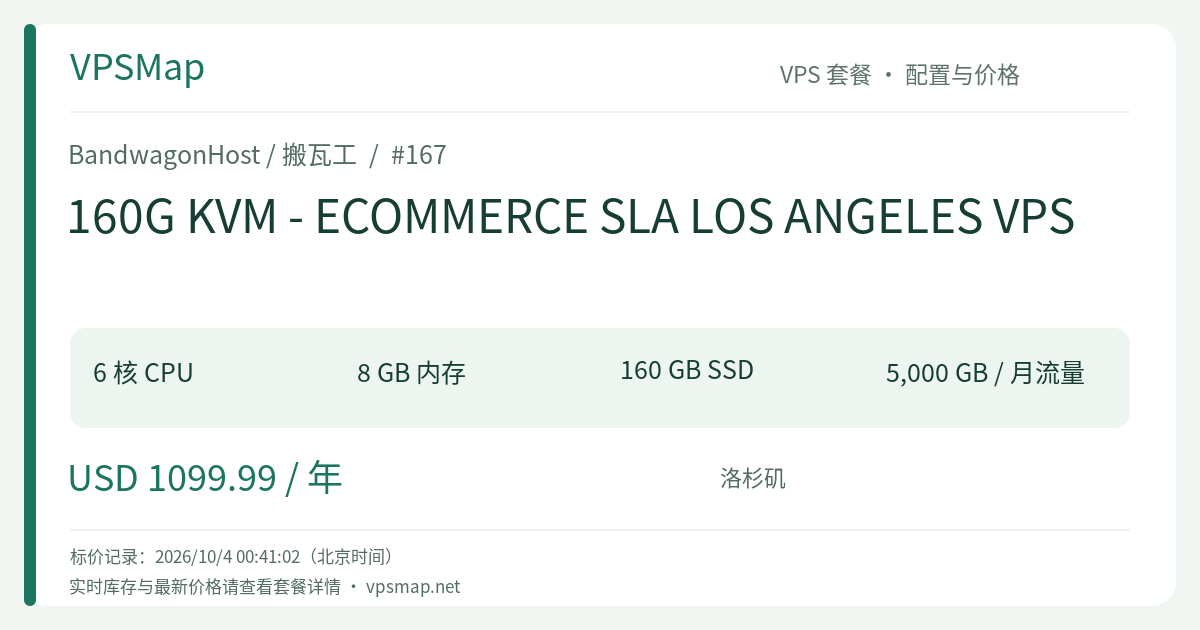
BandwagonHost Los Angeles 160G eCommerce SLA VPS Analysis: 100% Unrestricted 6 Cores 24/7 with 5 Gbps Uplink
Updated
The Transformative Advantage in the Terms of Service: Unrestricted 24/7 CPU Load#
When purchasing virtual private servers, most administrators scrutinize CPU core counts, memory size, and NVMe disk quotas, while completely ignoring the Fair Share CPU policies buried inside the Terms of Service (ToS).
In standard shared virtualized environments, host providers strictly cap sustained CPU utilization to keep noisy neighbors from starving the host node. For example, BandwagonHost's standard Promo or Limited Edition plans typically enforce a 1-hour average load limit of 20% to 50% of a single core. If your workloads require sustained multi-core processing—such as database re-indexing, big-data crunching, or extensive continuous compilation—your CPU frequency is automatically throttled down by the hypervisor.
However, a close examination of BandwagonHost's official Terms of Service (Section: Central processor resources) reveals an extraordinary contractual guarantee:
"SLA Plan / any plan with Service Level Agreement: All available cores 24/7 (no limit)"
This means that on this 160G KVM - ECOMMERCE SLA LOS ANGELES VPS (PID 167), all 6 dedicated-grade vCPU cores are permitted to run at a full 100% load, 24 hours a day, 7 days a week, 365 days a year, with zero automated throttling, no frequency capping, and no administrative intervention. This single contractual term transforms this server from a standard multitenant VPS into a resilient virtual workstation rivaling dedicated bare-metal instances.
Enterprise Network Backbone: 8×10GbE Links and a Massive 5 Gbps Uplink#
Complementing its unrestricted compute capacity is a world-class network architecture. BandwagonHost operates an aggregate of 8 × 10 GbE (80 Gbps total capacity) dedicated cross-facility backbones connecting its Los Angeles facilities.
Within flagship clusters (including the renowned USCA_9 / DC9 and DC6 facilities), all China-inbound traffic is dynamically routed across three premium Tier-1 carrier routes:
- China Telecom: AS4809 CN2 GIA / CTGNet elite direct routing
- China Mobile: AS58807 CMIN2 second-generation premium enterprise route
- China Unicom: AS10099 CU Premium (Unicom's top-tier international route)
Additionally, the node maintains direct peering with Google and major local carriers in Los Angeles. To cap it off, Plan #167 [Buy direct ↗] provisions a massive 5000 Mbps (5 Gbps) uplink port and a generous 5000 GB (5 TB) monthly data quota. When flash-sale traffic surges or large data sets sync across continents, the 5 Gbps pipe absorbs and delivers the spikes with zero packet queueing.
Hardware and Resource Profile: Plan #167 at a Glance#
Below is the complete engineering specification for PID 167:
| Specification | Details |
|---|---|
| vCPU Cores | 6 Cores (SLA Guaranteed: 100% 24/7 unrestricted load allowed) |
| Memory | 8192 MB (8 GB enterprise ECC RAM) |
| Storage | 160 GB SSD (Fully redundant enterprise storage array) |
| Uplink Port | 5000 Mbps (5 Gbps ultra-high throughput) |
| Data Transfer | 5000 GB / month (5 TB premium bi-directional bandwidth) |
| Network Routing | Los Angeles Tri-Carrier GIA/CMIN2/9929 + Direct Google Peering |
| SLA Terms | Backed by formal Service Level Agreement uptime & credit guarantees |
| Annual Price | $1099.99 / year (Under $92/mo equivalent; see dynamic site status) |
Comparison within the eCommerce SLA Family:
- 40G KVM ECOMMERCE SLA (PID 165): 3 Cores / 2GB RAM / 40GB SSD / 2000GB Traffic / 2.5 Gbps Port ($399.99/yr)
- 80G KVM ECOMMERCE SLA (PID 166): 4 Cores / 4GB RAM / 80GB SSD / 3000GB Traffic / 2.5 Gbps Port ($699.99/yr)
- 160G KVM ECOMMERCE SLA (PID 167): 6 Cores / 8GB RAM / 160GB SSD / 5000GB Traffic / 5 Gbps Port ($1099.99/yr)
Stepping up from the 80G plan to PID 167 increases cores from 4 to 6, doubles system memory to 8GB, doubles port throughput to 5 Gbps, and boosts monthly quota to 5TB, providing phenomenal economies of scale.
Why This Machine Serves as the Anchor for eCommerce and Production#
1. High-Concurrency Independent E-Commerce (Shopify Headless / WooCommerce / Magento)#
Independent merchant platforms dread two disaster scenarios during sales campaigns: sudden traffic spikes exhausting server CPU and triggering provider throttling, or transpacific packet loss dropping user checkout sessions and failing credit card processing. With 6 unrestricted cores and a 5 Gbps optimized link, PID 167 powers through thousands of concurrent PHP-FPM / Node.js threads while maintaining crisp, low-jitter checkout connections across the Pacific.
2. Multi-Container Orchestration and Microservice Hubs#
An 8GB memory footprint paired with 6 unthrottled cores provides a capable staging or production single-node Docker Swarm / Kubernetes cluster. You can host an entire application architecture simultaneously:
- Nginx / Caddy edge proxy with hardware SSL offloading
- PostgreSQL / MySQL primary relational database
- Redis caching instances and task queues
- Elasticsearch backend or log aggregation engines
- CI/CD build agents and automated test runners
3. Massive Transpacific Data Pipelines and High-Speed Mirroring#
A 5TB monthly bandwidth allowance and 5 Gbps port allow this server to act as a mission-critical bridge between North American and Asian facilities. Hundreds of gigabytes of database dumps, nightly off-site backups, and high-frequency API synchronization execute in minutes rather than hours.
Calculating the True TCO: Comparing with AWS & Google Cloud#
When evaluating PID 167 against Tier-1 hyper-scalers (AWS EC2 / Google Cloud Compute Engine), the economic contrast is striking:
- Base Compute & Disk Costs: Running an equivalent 6-8 core, 8-16GB RAM instance (e.g.,
c6i.2xlarge) 24/7 on AWS costs approximately $1,500 to $2,000 annually just for compute, with an additional $200/year for 160GB of provisioned SSD storage. - Egress Bandwidth Charges (The Hidden Cost Trap): AWS and Google Cloud do not offer CN2 GIA or CMIN2 optimized routes to China on standard instances; traffic travels over congested generic transit. Even on standard transit, outbound egress costs around $0.08 to $0.12 per gigabyte. Exiting 5 TB (5,000 GB) monthly generates a bandwidth invoice of $400 to $600 each month, adding up to $5,000 to $7,000 per year in network costs alone!
In contrast, BandwagonHost's 160G KVM ECOMMERCE SLA plan delivers everything for $1099.99/year all-inclusive (approx. $91.66/month)—including 6 unrestricted cores, 8GB RAM, 160GB enterprise SSD, and 5TB of triple-carrier optimized CN2 GIA/CMIN2/9929 data transfer. For engineering teams evaluating bottom-line return on investment, this server unlocks thousands of dollars in annual savings.
Operational Boundaries and Final Recommendation#
Despite SLA privileges and massive 5 Gbps capacity, basic operational standards apply:
- Storage I/O Safeguards: Sustained I/O rates exceeding 100 MiB/s for more than 4 consecutive hours should be avoided to preserve host disk health (typical database and web traffic remain well within limits).
- Acceptable Use: Strict compliance with ToS applies (no spam, unauthorized port scanning, or copyright infringements).
If you need a resilient, unthrottled, multi-carrier transpacific workhorse for production databases, independent e-commerce stores, or enterprise microservices, 160G KVM ECOMMERCE SLA (PID 167) stands as BandwagonHost's most commercially valuable offering.