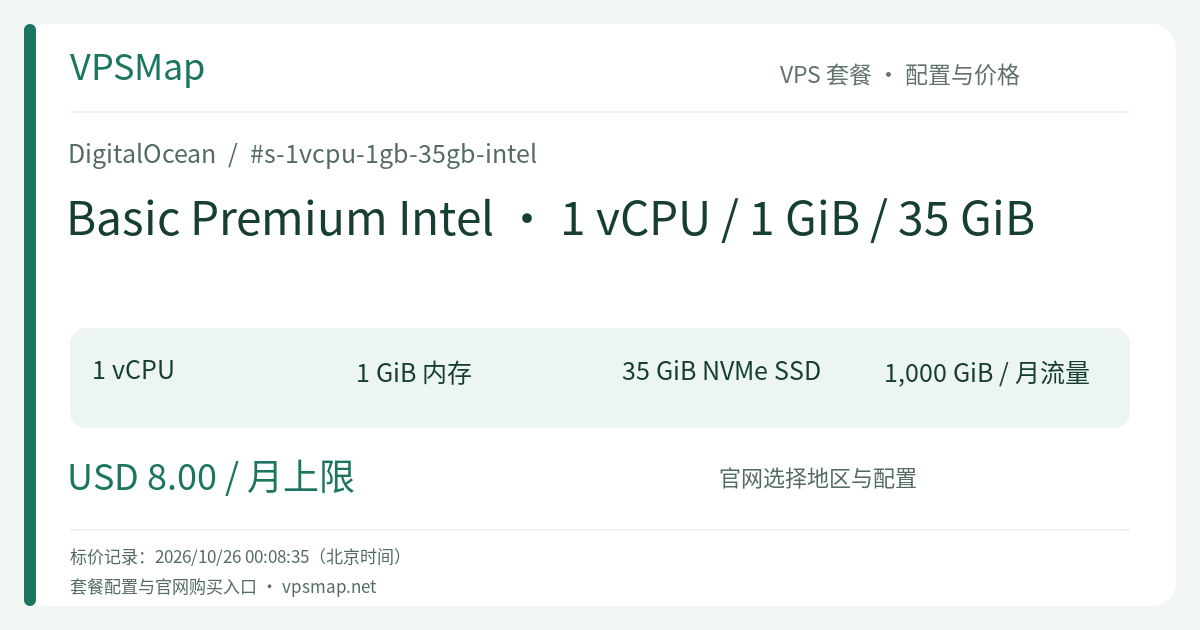
DigitalOcean 1 vCPU / 1 GiB / 35 GiB Premium Intel Droplet: Why the $1 Extra Storage Buffer Is Worth Every Cent
Updated
The Hidden Risk of Budget Hosting: Root Disk Exhaustion#
Anyone who has maintained small cloud instances in production has likely encountered this frustrating scenario: a service unexpectedly drops offline, not because of code defects or network outages, but because the root filesystem ran out of disk space.
On standard 25 GiB instances, the operating system base, security patch archives, system logs (/var/log), and container images routinely consume 12 to 18 GiB. When available space dips below 2–3 GiB, a routine automatic kernel update, a temporary Docker build cache, or database WAL accumulation can instantly push disk utilization to 100%, causing databases to lock and services to crash.
To solve this operational headache, DigitalOcean offers the Basic Premium Intel · 1 vCPU / 1 GiB / 35 GiB configuration (s-1vcpu-1gb-35gb-intel). It retains the identical high-frequency Intel Xeon Scalable processor and 2933 MHz RAM, but expands the local NVMe boot disk to 35 GiB for just an extra $1 per month.
Why an Extra 10 GiB of NVMe Storage Matters#
On paper, a 10 GiB upgrade (a 40% boost over base) might seem modest, but in day-to-day operations, it represents the divide between constant maintenance and peaceful stability:
- Effortless Docker Image & Cache Management: Modern deployments rely on containers. Even a modest setup—an Nginx edge proxy paired with an application container—accumulates dangling layers across version rollouts. A 35 GiB drive gives you room to pull new images before pruning old ones without risking disk saturation.
- Safe Log Retention and Diagnostics: Maintaining compliance or conducting post-incident reviews requires keeping historical access and error logs. The extra 10 GiB buffer allows log rotation scripts (
logrotate) to compress and archive millions of lines of logs locally. - Far Cheaper Than Block Storage: Attaching a separate block storage volume adds complexity, requires mount automation, and incurs minimum billing limits. Expanding the native NVMe root partition directly provides maximum read/write performance at the lowest possible cost.
Target Use Cases#
1. Containerized Micro-Services with Docker Compose#
Run compact full-stack apps (e.g., a Go/Node API + Caddy Web server + SQLite or Redis database) inside Docker Compose. The 35 GiB NVMe drive ensures seamless container upgrades and image pulls without disk exhaustion.
2. Standalone Lightweight Databases#
For embedded database architectures like PocketBase, SQLite, or low-write PostgreSQL instances backing internal tooling, personal wikis, or mobile backends, native NVMe keeps write latency negligible while the 35 GiB partition accommodates years of data and local database snapshots.
3. Long-Running Automation and Data Staging#
If you run scheduled web scrapers or data aggregation workers, the expanded drive acts as a reliable local staging area to process files, compress archives, and upload payloads to object storage (like DigitalOcean Spaces) safely.
Best Practices for Disk Health#
Even with a generous 35 GiB ceiling on an entry-level Droplet, practicing basic disk maintenance ensures longevity:
- Verify Log Rotation: Ensure
/etc/logrotate.confcompresses logs with gzip and retains a fixed number of rotations. - Automate Docker Housekeeping: Schedule a weekly cron job to clean up unused build layers and dangling images:
docker image prune -a --filter "until=168h" -f - Activate Free Threshold Alerts: Configure alert policies inside DigitalOcean Monitoring to notify your team via Slack or email if disk usage ever crosses 80%.
The Verdict: Unmatched Operational Insurance#
For a minimal cost increment, upgrading to the 35 GiB Intel tier delivers a 40% storage cushion that effectively eliminates root disk panics. It is an exceptional balance of lean budget efficiency and production-grade reliability.
Notice: Datacenter inventory and regional capacity are confirmed dynamically in the DigitalOcean console during deployment. Bundled Droplets benefit from predictable per-second billing with a monthly 672-hour cap.